Showing posts with label EGTB. Show all posts

Friday, 1 June 2018

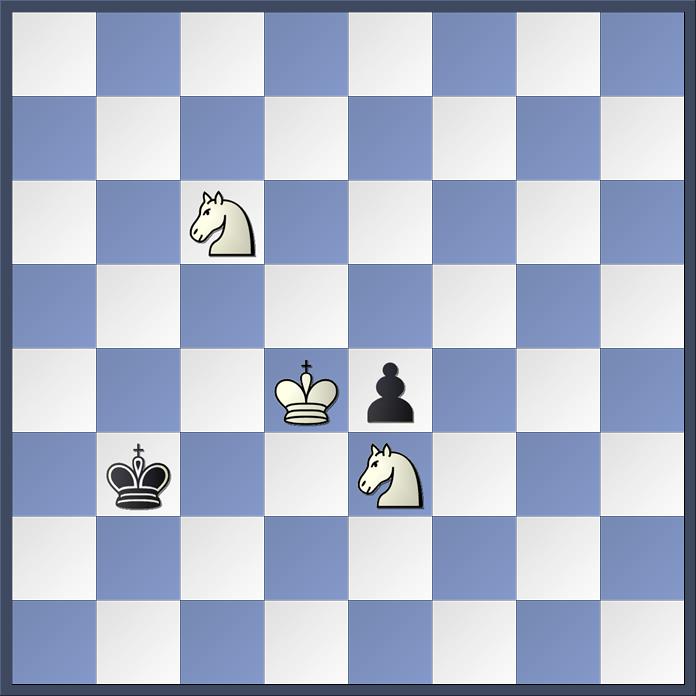
Study 150

Árpád Rusz
Jirtdan Ty
2018
Special Commendation

White wins

1. d4 Nf3 1... Ne2 2. d5 Nc3 3. d6! Nxa4 4. d7 +- 2. d5 Ne5 2... Nd4 3. Kf6 +- 3. d6 3. Ke6? Nc4 = 3... Kg5 In order to win, white has to reach the same position but with black to move.


cyclic zugzwang - WTM

4. Ke6 Nd3 5. Bb5 5. d7? Nc5+ =; 5. Bc2? Nc5+ 6. Kd5 Nd7 = 5... Nf4+ 6. Kf7! Thematic try: It is too early for 6. Kd7?! (Position X') 6... Ng6 7. Bd3? Ne5+ 8. Ke6 Nxd3 9. d7 Nc5+ = 6... Ng6 7. Ba4! 7. d7? Ne5+ =; 7. Bc6? Ne5+ = 7... Ne5+ 7... Kf5 8. Bc2+ +- 8. Ke7! White has managed to transfer the move to black. While the white king made a triangle manoeuvre (Ke7-e6-f7-e7, 3 moves) and the bishop a switchback (Ba4-b5-a4, 2 moves), the black knight walked on a diamond-shaped path (Ne5-d3-f4-g6-e5, 4 moves). These manoeuvres result in a tempo loss by white.


cyclic zugzwang - BTM

8... Ng6+ 8... Kf4 9. Kf6! (9. Ke6? Nd3 positional draw 10. Kd5 Ne5 11. Ke6 Nd3 positional draw) 9... Ke4 10. Ke6 Nd3 11. Bc2 +- pin 9. Ke6 Nf4+

10. Kd7! (Position X) 10... Kf6 10... Ng6 11. Bc2 Ne5+ 12. Ke6 +- Now d3 is not available for the knight. Please, compare it with the thematic try. 11. Kc8! Nd5 12. Bb3! 12. d7? Nb6+ = 12... Ke5! 12... Ke6 13. d7+- pin 13. Kd7! Switchback 13... Nf6+ 14. Ke7 Kf5 15. Ba2(c4,f7) tempo 15... Ke5 16. Be6 +-

Watch this study on a dynamic board! Click here!

Related study: Study 73

Friday, 5 January 2018

Study 142

Árpád Rusz
Krug-50 JT
2017
1st Special Prize
- after Bourzutschky & Konoval -

White wins

Try: 1. Rc6+? Kd7 In the following two variations black saves the game by sacrificing the knight or the rook. This provides some comfort for the fact that in the actual mainline these two black pieces are captured on their initial squares. 1... Ke7? 2. Ne3! knight sacrifice 2... Nxe3 3. Kxf4 +- 2. Rc5 2. Ne5+ Ke7 3. Nxd3 cxd3 4. Bxd3 Nxb4! knight sacrifice (4... Rf3? 5. Be4 Rg3+ 6. Kh4 Rxc3 7. Bxd5 +-) 5. cxb4 Rxb4 = 2... Rxg4+! rook sacrifice 3. Kxg4 Nf6+ 4. Kf4 Nxh7 4... Bxh7? 5. Ke5! Ng4+ 6. Kd4 +- 5. b5 Nf8! 6. Ke5 Ng6+ 7. Kf6 Kd6 8. Rc6+ Kd7 9. Rc5 Kd6 positional draw

Solution: 1. Bg8+ Kd6 2. Rc6+! rook sacrifice (2. Bxd5? Rf5+ 3. Kh4 Kxc7 =) 2... Kxc6 3. Bxd5+ Kd6! The black king triangulates! (3... Kxd5 4. Kxf4 black is in zugzwang Be2 (4... Ke6 5. Ne5 Be2 6. Ke4 +-) 5. Ne3+ Ke6 6. Ke4 +-) 4. Kxf4 Kxd5


1st cyclic zugzwang - WTM

In order to win, white must reach the same position but with black to move. The shortest manoeuvre to pass the move to black lasts 35 moves! All moves from the cycle are unique optimal moves. 5. Ne3+ (5. Nf2?! Be2 6. Kf5?! Bd3+ 7. Kf6? Bc2! 8. Ke7 Ba4 =) 5... Ke6 6. Nd1 Kd5 7. Nb2 White threatens to bring the knight to c5. 7... Bc2! 8. Kg5 Bd3 (8... Ke4 9. Kf6 Kd5 10. Ke7 Bf5 11. Kd8 +-) 9. Kf6 (9. Na4? Ke5 =) 9... Kd6 White should bring the knight to a5 before he continues the king manoeuvre. 10. Nd1! (The shortest path to a5 via a4-c5-b7 doesn't work: 10. Na4?! Be4 11. Nc5 Bc6!; If the king starts the manoeuvre too soon, its knight gets stuck on b2: 10. Kf7?! Bf1 11. Ke8 Be2 12. Kd8 Kc6! 13. Ke7 Kb5! Now, in order to win, white has to free its knight... 14. Ke6 Bg4+ 15. Ke5 Bf3 16. Kf4 Be2 17. Ke3 Bh5 18. Kd2 Bg6 19. Ke2! Quicker than the immediate 18.Nd1. It is better to lure the bishop to f5 first using a triangulation. 19... Bh5+ 20. Ke3 Bg4 21. Kd2 Bf5 22. Nd1 Now the knight is free but also the black king! 22... Kc6 23. Ke3 Kd5 24. Nb2 Bg6 25. Kf4 Bc2 and we have returned to a previous position from the main line) 10... Be4 11. Ne3 Bd3 12. Ng4 Be2 13. Ne5 Bd3 14. Nf7+ Kd5 This move blocks the a8-h1 diagonal allowing the knight to go to b7. (14... Kd7 15. Ke5 +-) 15. Nd8! Kd6 16. Nb7+ Kc7 17. Na5! (Moving immediately to c5 is wrong: 17. Nc5?! Kd6 and the white king cannot move to f5.) 17... Kd6 18. Kf7 Kd7 19. Nb7! Black is in zugzwang! 19... Be2 (The bishop cannot move to the big diagonal: 19... Be4 20. Nc5+ +-) 20. Kf6 Kc7 21. Nc5 Kd6 22. Kf5 The bishop was not on d3! 22... Kd5 23. Kf4 Bf1 This is a new cyclic zugzwang position! (23... Bd3 24. Nxd3 cxd3 25. Ke3 Kc4 26. Kd2 +-)


2nd cyclic zugzwang - WTM

White will lose a tempo by a square-shaped manoeuvre (Nc5-d7-f6-e4-c5) while the black king triangulates (Kd5-d6-e6-d5). 24. Nd7 (It is too early to bring the knight to a4: 24. Na4? Be2 25. Ke3 Bd3 White is in zugzwang! 26. Nb6+ Kc6 27. Nc8 Kc7 28. Ne7 Kd6 29. Ng8 Ke5) 24... Kd6 25. Nf6 Ke6 26. Ne4 Kd5 27. Nc5


2nd cyclic zugzwang - BTM

27... Be2 28. Na4! Bd3 29. Ke3 Black is in zugzwang! The bishop has to leave the good square from which it controls the b1-h7 diagonal. 29... Bf1 30. Nb6+ Ke5 (In the following variation we can see the drawback of leaving the b1-h7 diagonal: 30... Kc6 31. Nc8 Kc7 32. Ne7 Kd6 33. Ng6! Kd5 (33... Bd3 34. Nf4 +-) 34. Kf2 Bd3 35. Nf4+ Ke4 36. Nxd3 Kxd3 37. b5 +-) 31. Kf3! This is a waiting move to lure the bishop to d3! (The immediate Nd7 is refuted by Ke6. 31. Nd7+?! Ke6) 31... Bd3 32. Nd7+ Kd6 (Ke6 is not that strong anymore: 32... Ke6 33. Nc5+ Kd5 34. Nxd3 cxd3 35. Ke3 Kc4 36. Kd2 +-) 33. Nc5 By attacking the bishop, white wins a crucial tempo. The black king cannot go back to the fifth rank, so the bishop must control e4. That means it has to leave the d3-f1 diagonal. 33... Bf5 The bishop also takes under control the important d7 square. 34. Kf4! (34. Ke3?! would throw away all the progress we have done so far. Ke5 M111 35. Na4 Bd7 36. Nb2 Be6 37. Kd2 Bd5 38. Nd1 Be4 39. Ne3 Bd3 40. Ng4+ Kf4 41. Nf6 Bf5 42. Nd5+ Ke4 43. Ne3 Be6 44. Nc2 Bg4 45. Nd4 Ke5 46. Kc1 Kd6 47. Kc2 Bh5 48. Nf5+ Ke5 49. Ne3 Bf7 50. Kb2 Ke4 51. Nc2 Bh5 52. Nd4 Kd5 53. Ka3 Bd1 54. Nf5 Kc6 55. Ne3 Bb3 56. Kb2 Kc7 $1 57. Nf5 Ba4 58. Kc1 Kd7 59. Nh6 Kd6 60. Kd2 Ke5 61. Ke3 Bd1 62. Nf7+ Ke6 63. Ng5+ Ke5 64. Ne4 Bc2 65. Nd2 Bd3 66. Nf3+ Kd5 67. Nh2 Bc2 68. Kf4 Bb1 $1 69. Ng4 Bd3 and we have returned to the cyclic zugzwang position from the main line) 34... Bg6 35. Ke3 Kd5 (35... Ke5 36. Nd7+ now that the bishop has left f5 this move works Kd5 37. Nb6+ +-) 36. Nd7 The threat is Nb6+ 36... Bd3 37. Nf6+ Ke5 38. Ng4+ Kd5 39. Kf4 +-


1st cyclic zugzwang - BTM

Watch this study on a dynamic board! Click here!


This study is based on the following computer endgame which is the longest win for KNPPKBP:

M. Bourzutschky & Y. Konoval
EG#188
2012

"For the KNPPKBP endgame the longest win is 102 moves and there is only one record position." 1. Na3 Kg2 2. Nb5 c6 3. Nd4 c5 4. Nb5 Kg3 5. Nc7 Bc8 6. Na8 Ba6 7. Nb6 Kf4 8. Nd7 c4 9. b4 Bb5 10. Nc5 Ke5 11. Nb7 Bc6 12. Na5 Bb5 13. Kb2 Kd5 14. Nb7 Bc6 15. Nd8 Kd6 16. Nf7+ Ke6 17. Nh6 Ke5 18. Kc2 Bd5 19. Ng4+ Kf4 20. Nf2 Bf3 21. Kc1 Kf5 22. Kd2 Ke5 23. Ke3 Bg2 24. Nd1 Bh3 25. Kd2 Bf5 26. Ne3 Bd3 27. Ng4+ Kf4 28. Nf6 Bf5 29. Nd5+ Ke4 30. Ne3 Be6 31. Nc2 Bg4 32. Nd4 Ke5 33. Kc1 Kd6 34. Kc2 Bh5 35. Nf5+ Ke5 36. Ne3 Bf7 37. Kb2 Ke4 38. Nc2 Bh5 39. Nd4 Kd5 40. Ka3 Bd1 41. Nf5 Kc6 42. Ne3 Bb3 43. Kb2 Kc7 44. Nf5 Ba4 45. Kc1 Kd7 46. Nh6 Ke6 47. Kd2 Ke5 48. Ke3 Bd1 49. Nf7+ Ke6 50. Ng5+ Ke5 51. Ne4 Be2 52. Nd2 Bd3 53. Nf3+ Kd5 54. Nh2 Be4 55. Kf4 Bg6 56. Ng4 Bd3 57. Ne3+ Ke6 58. Nd1 Bc2 59. Nb2 Kd5 60. Kg5 Bd3 61. Kf6 Kd6 62. Nd1 Be4 63. Ne3 Bd3 64. Ng4 Be2 65. Ne5 Bd3 66. Nf7+ Kd5 67. Nd8 Kd6 68. Nb7+ Kc7 69. Na5 Kd6 70. Kf7 Kd7 71. Nb7 Be2 72. Kf6 Kc7 73. Nc5 Kd6 74. Kf5 Kd5 75. Kf4 Bf1 76. Nd7 Kd6 77. Nf6 Ke6 78. Ne4 Be2 79. Nc5+ Kd5 80. Na4 Bd3 81. Ke3 Bf1 82. Nb6+ Ke5 83. Kf3 Bd3 84. Nd7+ Kd6 85. Nc5 Bf5 86. Kf4 Bg6 87. Ke3 Kd5 88. Nd7 Bd3 89. Nf6+ Ke6 90. Ng4 Kd5 91. Kf4 Be2 92. Ne3+ Kc6 93. Kf5 Bd3+ 94. Ke5 Kb6 95. Nf5 Kb7 96. Nd4 Ka6 97. Ke6 Be4 98. Nf5 Bc6 99. Nd6 Ba4 100. Ke5 Bb3 101. Kd4 Kb6 102. Nxc4+ +- "Attention, please! After 9.b4!! White has to make 92 moves without moving a pawn and capturing. A surprising example of a 50 move rule exception!"

Wednesday, 18 October 2017

Study 129

Michael Byrne & Árpád Rusz
Shakhmatnaya Kompozitsia
2017

White wins

1. Ka5! 1. Kb5? Bd3+! 2. Rxd3 Rxc1 = 1... Bc2! 2. Bxa3! 2. Rxa1+? Kxa1 3. Bxa3 b2 = 2... Kxa3 3. R1xc2! 3. Rxa1+? Kb2 = fork

Main 1:
3... Ra2 4. Rc1 Rg2!


5. Rf3!!

Thematic try: 5. Rh3? Rg5+ 6. Kb6 Rg6+ 7. Kb5 Rg5+ 8. Kc4 Ka2 9. Kb4 Rg4+ 10. Kc3 b2 11. Rc2 Ka1! 12. Rxb2 Rg3+! 13. Rxg3 stalemate 5... Rg5+ 6. Kb6 Rg6+ 7. Kb5 Rg5+ 8. Kc4 Ka2 9. Kb4 Rg4+ 10. Kc3 b2 11. Rc2 Ka1 12. Rxb2 +-

Main 2:
3... Rh1


4. Rf2!!

1st thematic try: 4. Rg2? Rh3 5. Rc4 Rh5+ 6. Ka6 Rh3/Rh6(8) 7. Kb5 Rh5+ 8. Kc6 Rh6+ 9. Kd5 Rh5+ 10. Ke6 Rh6+ 11. Kf5 Rh5+ 12. Kg6 (12. Kf6 Rh6+ 13. Kg5 Rh8! 14. Kf6 Rh6+ positional draw) 12... Rb5 13. Rg3 Ka2 14.Ra4+ Kb1 15. Rg1+ Kb2 16. Kf6 Rc5 17. Ke6 Rc1 18. Rg3 Rc3 19. Rg8 Kb1 20. Ra3 Kb2 21. Rga8 Kc2 = Position X'. The white king is too far to help.

4... Rh3! 5. Rc4 5. Rxh3? stalemate 5... Rh5+ 6. Ka6! 6. Kb6? b2 7. Rf3+ Ka2 8. Ra4+ Kb1 9. Rf1+ Kc2 10. Rb4 Kc3 = 6... Rh3 6... b2 7. Rf3+ Ka2 8. Ra4+ Kb1 9. Rf1+ Kc2 10. Rb4 Kc3 11. Rb8 +- 7. Kb5 Rh5+ 8. Kc6 Rh6+ 9. Kd5/Kc(d)7 9... Rh5+ 10. Kd(e)6 10... Rh6+ 11. Ke5(7) 11... Rh5+ 12. Kf6 Rh8! 13. Kf7! 13. Kg7? Rb8 = 13... Rh7+ 14. Kg6 Rb7 15. Rf3 Ka2 16. Ra4+ Kb1 17. Rf1+ Kb2! 17... Kc2 18. Rc4+ Kd3 19. Rcc1 b2 20. Rfd1+! Ke2 21. Rb1 +- 18. Kf6! Rc7 19. Ke5! In contrast to the thematic try, there was no rook protecting the fifth rank. 19... Rc1 20. Rf3 Rc3 21. Rf8! White doesn't allow a black counterplay based on Rc8. 21... Kb1 22. Ra3! The only way to stop the pawn is by pinning. 22... Kb2 23. Rfa8 2nd thematic try: 23. Kd4? Rh3! 24. Ra7 Rh4+ 25. Ke5 Rh5+ 26. Kf4 Kb1! Black uses the poor position of the f8 rook which is obstructed by its own king. 27. Rb8 b2 = This try failed only because the rook was on the f-file so white will start a manoeuvre to reposition the rook to another file. 23... Kc2 Position X. Now the white king is closer compared to Position X' reached in the 1st thematic try.


Position X


Position X'

24. Kd4! Rd3+ 25. Ke4! White leaves the c-file open for a rook check. 25. Kc4? b2 26. Rxd3 b1=Q = 25... Rc3 26. Rg(h)8 Kb2 26... b2 27. Rg2+ Kd1 28. Rxc3 b1=Q+ 29. Rd3+ Ke1 30. Rg1+ +- 27. Kd4! Unlike the 2nd thematic try, now that the rook was repositioned from f8, this plan works.27...Rc2! Although the best square for the black rook is c1, black deliberately wastes a tempo before putting it there trying to play for a zugzwang. 28. Rga8 28. Ra4? Kb1 29. Rc4 b2 = Now we see the reason for moving the black rook to c2 instead of c7. With an unprotected rook, this pawn move wouldn't be possible. 28... Rc1 The threat 29.Ra1 had to be stopped. Now white seems to be in zugzwang but it still can win by transferring the move to black.


cyclic zugzwang - WTM

29. R3a4(5,6,7) White threatens to put a rook to the b-file. Beside occupying the first rank, this is white's other plan to win. 29... Kb1! Black aims for a fortress by trying to push the pawn. 30. Ra1+ 30. Rb7? b2 = fortress 30... Kb2 31. R1a3!


cyclic zugzwang - BTM

31... Rh1 Black has to keep the rook on the first rank. 32. R3a5(6,7) 32... Kb1 This is the last try to build the fortress. Now that the black rook has moved from c1, this move loses immediately. 33. Ra1+ +-

Watch this study on a dynamic board! Click here!

Tuesday, 29 August 2017

Study 121

Árpád Rusz
Shakhmatnaya Kompozitsia
2017
2nd Honourable mention

White wins

1. Ng3 The knight takes the e4 square from the black king. 1... Nd6 1... Ke3 2. f5 Kf4 3. b4! Kxg3 4. b5 Kf4 5. b6 Nd6 6. f6 Ke5 7. b7! (7. f7? Nxf7+ =) 7... Nxb7 8. f7 +- 2. Kg7 2. f5? Ke5 3. Kg7 Nxf5+ 4. Nxf5 Kxf5 = 2... Ne4 Now the white knight has to leave. Fortunately, the black king still cannot attack efficiently the f-pawn because the e4 square is blocked. 2... Ke3 3. f5 Kf4 4. Kf6! Kxg3 5. Ke6 +-

3. Nh1!! The only way to win is by a Switchback move and a voluntary self-incarceration of the white knight! The knight had 5 other squares to go, let's see why were they wrong:
3. Nxe4? Kxe4 4. b4 Kxf4 5. b5 Ke5 6. b6 Kd6 7. b7 Kc7 =;
1st thematic try: 3. Nh5? Kc4 4. Kf7 Kb3 5. Ke6 Kxb2 6. Ke5 Position 1 6... Nf2! =;
2nd thematic try: 3. Nf1? Kc4 4. Kf7 Kb3 5. Ke6 Kxb2 6. Ke5 Position 2 6... Nc5! = (6... Nf2? 7. f5 Ng4+ 8. Ke6 Kc3 9. Ne3! +- echo sacrifice);


echo sacrifice

3. Nf5+? Kc4 4. Ne3+ Kd3 5. Nd1 Nd6 6. Kf6 Ke4 7. Kg5 Nf7+ 8. Kg4 Nh6+ 9. Kg3 Nf5+ 10. Kg4 Nh6+ 11. Kg5 Nf7+ perpetual check;
3. Ne2+? Ke3 4. f5 Kxe2 =
3... Kd5! 3... Kc4 4. Kf7! Kb3 5. Ke6 Kxb2 6. Ke5 Position 3 6... Nc5 7. Nf2! +-; 3... Ke3 4. f5 Kf4 5. f6 Nxf6 6. Kxf6 +- 4. f5 4. Kg6? Ke6 5. f5+ Ke5 mutual zugzwang 6. b4 Kd5 7. b5 Kd6! 8. Ng3! Nxg3 9. f6 Ne2 10. f7 Nf4+ 11. Kf5 Ne6 12. b6 Nf8 13. b7 Kc7 = 4... Kc4! Only now! Kf7 is not possible anymore. 4... Ke5 5. Kg6 +- mutual zugzwang 5. Kg6! 5. Kf7? Nd6+ 6. Ke6 Nxf5 7. Kxf5 Kb3 = 5... Kb3 6. Ng3! +- White white wins repeating the first move from the initial position.


echo sacrifice

Watch this study on a dynamic board! Click here!

Monday, 6 March 2017

Study 110

Árpád Rusz
RCS blog
2017

Win

1. Nfe5 Rxe3! 2. Nc4+! 2. Kxe3? Kxb3 = 2... Ka2! Triangulation by the black king! If black captures the pawn immediately, the win is much easier: 2... Kxb3 3. Nxe3 Ka3 4. Kc3 Ka4 5. Kc4 Ka3 6. Nd4 Ka4 7. Nb3 Ka3 8. Nc5 +- etc.) 3. Nxe3 Kxb3 The pawn is securely blockaded by a white knight exactly on the Troitzky line, so by the theory, white must win. The win is surprisingly difficult: white can win only by reaching the same position but with black to move! This can be done only by a 45-move-long manoeuvre!! The play is determined except some duals which can be regarded as minor ones.


cyclic zugzwang - WTM

4. Nd8 The minor duals 4. Ne5 Kb4 5. Ng6 Kb5 6. Nf4; 4. Ne7 Kb4 5. N7d5+ (5. Ng6 Kb5 6. Nf4) 5... Kb5 6. Ke5 (6. Nf4) 6... Kc6 7. Nf4 are all quickly reaching the main line 4... Kb4 5. Ne6 Kb5 6. Nf4 Kc6 7. Ke5 Kd7 8. Kd5 Kc7 9. Ke6 Kc6 10. Ne2! Kc5 11. Kd7 Kb6 12. Kd6 Kb5 13. Kd5!


critical position A

13... Kb6 13... Kb4 14. Kc6 +- 14. Nd4 Kb7 15. Ke6 Ka6 16. Ne2! Kb7 17. Kd6 Kc8 18. Nf4 minor dual 18. Nd4 Kd8 19. Nc6+ Kc8 20. Na5 Kd8 21. Nb7+ Ke8 22. Ke6 Kf8 23. Nd6 etc. reaching the main line 18... Kd8 19. Ne6+/Nh3 Ke8 20. Ng5 Kd8 21. Nf7+ Ke8 22. Ke6 Kf8 23. Nd6 Kg7 24. Kf5 Kh7 25. Kf6 Kh6 26. Ndf5+/Nb5 Kh5 27. Ng3+/Nd4 Kh4 28. Ne2! Kh5 29. Kf5!This position looks like position A but reflected vertically!


critical position B

29... Kh6 The black king has to return... 29... Kh4 30. Kg6 +- 30. Nf4 Kg7 31. Ke6 Kf8 32. Nh5 Ke8 33. Ng7+ Kd8 34. Kd6 Kc8 35. Ne6 Kb7 36. Kc5 Ka6 37. Kc6 Ka5 38. Nc7/Nd4 Kb4 39. Nb5 Ka4 40. Kc5 Kb3 41. Kd4 Kb4 42. Nc7 Ka5 43. Kc5 Ka4 44. Ncd5 Ka5 45. Nb4 Ka4 46. Nc6 Ka3 47. Kd5!! Triangulation by white king! After 47. Kd4? Kb3 one has to start another 45-move long manoeuvre... 47... Kb3 48. Kd4! +-


cyclic zugzwang - BTM

This study features the longest known cyclic zugzwang (45 moves). That is an amazing new record! The study participated in the Troitzky-150 MT but it seems like the judge was not impressed enough to award it.

Watch this study on a dynamic board! Click here!

Wednesday, 29 June 2016

Study 77b

S. Didukh
Victory AT
2015
1st/2nd Prize

White wins

1. Re3+ Kd1! 1... Kxd2 2. Rbd3+ Kc2 3. Rc3+ Kd2 4. Red3+ +- 2. Ra3! 2. Rxe6? Nxb3 3. Kxb3 Bd5+ = 2... Bd5+ 3. Ka1! 3. Kb1? Nc4 4. Rad3 Be4! 5. Rxe4 Nxc5 = 3... Nc4 4. Rad3! Be4! 4... Nxe3 5. dxe3+! Ke2 6. Rxd5 +-; 4... Nf4 5. Rd4 +- 5. Rxe4 Nxc5 6. Rd8! 6. Rd5? Nxe4 7. d3 Kd2! mutual zugzwang 8. dxe4+ (8. dxc4+ Kc3 9. c5 Kc4! 10. c6 Kxd5 11. c7 Nd6 =) 8... Ke3 9. e5 Ke4! 10. e6 Kxd5 11. e7 Nd6 = 6... Nxe4 7. d3! Kd2 8. Rd5!


mutual zugzwang

8... Nb6 8... Nf6 9. dxc4+ Kc3 10. Rf5 Ne4 11. c5 +- 9. dxe4+ Ke3 10. Rb5 Nc4 11. e5 +-

Watch this study on a dynamic board! Click here!

Related studies: Study 77

Saturday, 11 June 2016

Study 93a

Árpád Rusz
Marwitz-100 MT, 2016
Special Prize
- version -

White wins

1.Rxa3+! 1.Qxh7? Rg5 2.Rxa3+ Qxa3+ 3.Kb7 Rb5+=; 1.f8Q? Qa5+ 2.Kb7 Qb5+ 3.Ka7 Qa5+ perpetual check 1...Qxa3+ 1...Kxa3 2.Qxh7 Rg5 3.Qd3++– 2.Kb8! 2.Kb7? Rgxg7 3.Rxa3+ Kxa3–+ 2...Qxa8+ 3.Kxa8 Rgxg7! Capturing the Queen leads to two echo positions: 3...Rxh8+ 4.Bxh8 h2 5.f8Q h1Q 6.Qf7+ Kb1 7.Qb3+ Kc1 8.Qb2+ Kd2 9.Qc3+ Ke2 (9...Kd1 10.Qa1++– echo position 1)

10.Qd3+ Ke1 11.Bc3+ Kf2 12.Qd2+ Kg3 13.Be5+ Kg4 14.Qf4+ Kh5 15.Qf5+ Kh6 16.Qf6+ Kh5 17.Qh8++– echo position 2

So back to the main line after black’s third move we have the following critical position on the board:

This could be a more economical starting position of the study. The main line and the two tries all feature different systematic movements!
Try1: 4.f8Q? Ra7+ 5.Kb8 Rab7+! (5...Rhb7+? 6.Kc8 Rc7+ 7.Kd8 Rd7+ 8.Ke8 Re7+ 9.Qxe7+–) 6.Kc8 Rbc7+ 7.Kd8 Rcd7+ 8.Ke8 Rde7+ 9.Qxe7 Rxh8+ 10.Kd7 h2 11.Qf7+ Kb1 12.Qb3+ Kc1= (12...Ka1? 13.Qc3++–);
Try2: 4.Qxg7? Rxg7 5.f8Q h2! (5...Rg3? 6.Qh6! Kb2 (6...f2 7.Qe6+ Kb1 8.Qb6++–) 7.Qd2!+–) 6.Qxf3

6...Rg8+!! Paradoxically, black lets the white king to escape from the eight rank! (The immediate 6...Rg1? loses because of a Queen staircase on the a and b-files from b3 to b8! 7.Qb3+ Ka1 8.Qa3+ Kb1 9.Qb4+ Ka1 10.Qa5+ Kb1 11.Qb6+ Ka1 12.Qa7+ Kb1 13.Qb8++– ) 7.Kb7 Rg1! (7...Rg7+? 8.Kc8!! Back to the eight rank! (8.Kc6? Rg1 9.Qb3+ Ka1 10.Qa3+ Kb1 11.Qb4+ Ka1 12.Qa5+ Kb1 13.Qb6+ Kc1!=) 8...Rg8+ 9.Kd7!+–) 8.Qb3+ Ka1 9.Qa3+ Kb1 10.Qb4+ Ka1(2) 11.Qa5+ Kb1 12.Qb6+ Ka1(2) 13.Qa7+ Kb1(2)=
Main: 4.Qxh7! It is a paradox that white captures the rook only after black managed to protect it.4...Rxh7

This could be an even more economical starting position. My feeling is that a lot would be lost with this simplification. 5.f8Q f2! 5...h2 6.Qg8++– 6.Qxf2 6.Qg8+? Ka1! 7.Qxh7 f1Q=; 6.c4? Rh8! 7.Qxh8 f1Q= 6...h2 7.c4+ Kb3 8.Qf3+ Kb4! 8...Kxc4 9.Qe4++– 9.Qh1 Kc5!

The plan that looks logical now is starting to move with the white king towards the rook. But it doesn't work yet! While the black king is on c5 the rook can leave the seventh rank (e.g. by moving to h5). 10.Qd5+ Kb4 11.Qd2+ Kc5 12.Qf2+ Kb4 13.Qb2+ Kc5 14.Qb5+ Kd4 15.Qd5+ Kc3 16.Qh1 Kd4 The black king is not on c5 so the white king can make a move towards the rook! 17.Kb8! The first step. 17...Kc5 Back to c5... White needs to repeat the manoeuvre to gain a tempo for another king move.

18.Qd5+ Kb4 19.Qd2+ Kc5 20.Qf2+ Kb4 21.Qb2+ Kc5 22.Qb5+ Kd4 23.Qd5+ Kc3 24.Qh1 Kd4 25.Kc8! The second step. 25...Kc5

26.Qd5+ Kb4 27.Qd2+ Kc5 28.Qf2+ Kb4 29.Qb2+ Kc5 30.Qb5+ Kd4 31.Qd5+ Kc3 32.Qh1 Kd4 33.Kd8! The third step. 33...Kc5

34.Qd5+ Kb4 35.Qd2+ Kc5 36.Qf2+ Kb4 37.Qb2+ Kc5 38.Qb5+ Kd4 39.Qd5+ Kc3 40.Qh1 Kd4 41.Ke8! The fourth step. 41...Kc5

42.Qd5+ Kb4 43.Qd2+ Kc5 44.Qf2+ Kb4 45.Qb2+ Kc5 46.Qb5+ Kd4 47.Qd5+ Kc3 48.Qh1 Kd4 49.Kf8! The fifth step. 49...Kc5

50.Qd5+ Kb4 51.Qd2+ Kc5 52.Qf2+ Kb4 53.Qb2+ Kc5 54.Qb5+ Kd4 55.Qd5+ Kc3 56.Qh1 Kd4 57.Kg8! +- The last step along the eight file.

The white king will finally escape from the last rank. White has a winning position. Notice that this was the 50th move since the last capture or pawn move (7.c4+), so according to the FIDE rules, this position would be a draw! Fortunately, endgame study composition codex doesn't care about that artificial "draw by 50 moves" rule!

Watch this study on a dynamic board! Click here!

Related study: Study 93.

Study 91

Árpád Rusz
Chessbase-25 JT
2011
9th Honourable Mention

White wins

1. b6! 1. bxc6? Qxc6 2. Qf5+ Kg3 3. Qg5+ Kf3 4. Qd5+ Qxd5 5. cxd5 Ke2! ( 5... Ke3? 6. d6 f3 7. d7 f2 8. d8=Q f1=Q 9. Qb6+! Ke2 10. Qe6+ Kd2 11. Qh6+ Ke2 12. Qh5+ Kd2 13. Qa5+ Ke2 14. Qe5+ Kd2 15. Qc3+ Ke3 16. Qc5+! Kd2 17. d4 +-; 5... Kg4? 6. d6 f3 7. d7 f2 8. d8=Q f1=Q 9. Qd7+! Kg5 10. Qd6! +-) 6. d6 f3 7. d7 f2 8. d8=Q f1=Q 9. Qe8+ Kd2 = 1... f3! 1... Qxd3+ 2. Qc3 +- 2. b7 Qxd3+ 2... f2 3. b8=Q Qxd3+ 4. Qc3 (4. Kb2? Qe2+ 5. Ka3 Qd3+ 6. Qb3 f1=Q 7. Qh5+ Kg2 =) 4... f1=Q 5. Qc8+! (5. Qbh8+? Kg2! 6. Qhg7+ Kh1! 7. Qh6+ Kg1 8. Qg5+ Kh1 9. Qh4+ Kg2! (9... Kg1? 10. Qg3+ Qxg3 11. Qxg3+ Kh1 12. Qh4+ +-) 10. Qg4+ Kh2! (10... Kh1? 11. Qxd3 Qxd3+ 12. Ka4 Qc2+ 13. Ka5 Qa2+ 14. Kb6 +-) 11. Qh4+ Kg2 positional draw) 5... Kh4 (5... Kh2? 6. Qc7+ Kh1 7. Qxc6+ +-) 6. Q8h8+ Kg5 7. Qhg7+ (7. Qhe5+? Qff5 8. Qxd3 Qxe5 = ) 7... Kh5 8. Qge5+ +- 3. Qc3 Qb1+! 4. Qb2 Qxb2+! 4... Qd3+ 5. Kb4 Qd6+ 6. Ka5 Qc5+ 7. Ka6 Qxc4+ 8. Kb6! Roman Theme (8. Ka7? Qc5+ 9. Ka8 Qa5+ =) 8... Qg8 9. Ka7 Qg1+ 10. Ka8 +- 5. Kxb2 f2 6. b8=Q f1=Q 7. Qc8+ 7. Qh8+? Kg4 8. Qg7+ Kh5 9. Qh7+ Kg5 10. Qg7+ Kh5 positional draw 7... Kh4! 8. Qxc6! Qd3! Now we see the reason why it was better for Black to exchange the Queens on b2 instead of c3.

9. Qb5! mutual zugzwang 9. Qd5? Qxd5 10. cxd5 Kg5 =; 9. c5? Kg5 10. Qd6 Qxd6 11. cxd6 Kf6 = 9... Kg4 10. Qc5! mutual zugzwang 10. Qb3? Qd2+ 11. Ka3 Qa5+ 12. Qa4 Qc3+ 13. Qb3 Qa5+ perpetual check 10... Kf4

11. Qe7!! Qxc4 11... Kf5 12. Qh7+ +- 12. Qh4+ +-

Watch this study on a dynamic board! Click here!

Friday, 10 June 2016

Study 79

Árpád Rusz
2nd UAPA Ty
2015
Special Prize
- after J. Bryant -

White wins

1.Kc5+! 1.Kd5+? Nf6+ 2.Ke6 hxg6 3.Bxf6+ Kh7 4.Bd4 gxh5 5.gxh5 Kg8 6.Kd7! catching the N 6...Kf7! 7.Kxc8 Ke6 8.Bg7 Kf5 9.Bxh6 Kg4!= 1...Nf6 2.gxh7 Kh8!! Triangulation 2...Kxh7 3.Bxf6 Kg8 4.Bd4 Ne7 5.Be3 Kg7 6.Kd6 Ng6 (6...Ng8 7.Ke6+–) 7.hxg6 Kxg6 8.Ke5 h5 9.g5+– 3.Bxf6+ 3.Kb4? Kxh7 (3...Nd6? 4.Bxf6+ Kxh7 5.Bd4+–) 4.Bxf6 Kg8=; 3.Kc6? Ne7+ 4.Kd6 Ned5=; 3.Be5?! Kg7 waste of time] 3...Kxh7 White needs to reach to same position but with BTM. The cycle to achieve this is 36 moves long!! That is a record. Surprisingly, this manoeuvre is almost free of duals (except time wasting duals, the only time when there is an alternative way for a few moves is at move 6 but that also leads to the main line some moves later).


Cyclic zugzwang - WTM

4.Bd4 Ne7 5.Kd6 Ng6!


Position A

5...Nc8+ 6.Kd7+– catching the N; 5...Ng8 6.Ke6+– zugzwang 6.Be5 [minor dual 6.Be3 Nh4 7.Ke5 Nf3+ 8.Ke4 Ne1 9.Bd2 Nc2 10.Kd3 Na3 11.Bf4 Nb5 12.Kc4 Na3+ 13.Kb4 Nc2+ 14.Kc3 Ne1 15.Kd2 etc. as in the main line; 6.hxg6+? Kxg6 7.Be3 h5=] 6...Nh4 7.Kd5 Nf3 8.Bf4 Ne1 9.Kc4 Kg7 10.Kd4! Kh7 11.Kc3 Ng2 12.Bd2 Nh4 13.Kd3 Nf3 14.Bf4 Ne1+ 15.Kd2 Nf3+ 16.Ke3 Ne1


Position B

17.Bg3 Nc2+ 18.Kd3 Nb4+ 19.Kc4 Nc6 20.Kc5 Na5 21.Bf4 Kg7 22.Kb6 Nc4+ 23.Kb5 Na3+ 24.Kb4 Nc2+ 25.Kc3 Ne1 26.Kd2 Nf3+ 27.Ke3 Ne1


Position B'

28.Be5+ Kg8 29.Bc3 Nc2+ 30.Kd3 Na3 31.Be5 Kf7 32.Bf4 Kg7 33.Kc3 Kh7 34.Be5 Nb1+ 35.Kc2 Na3+ 36.Kb3 Nb5 37.Kb4 Na7 38.Kc5 Nc8 39.Bf6


Cyclic zugzwang - BTM

39...Kg8 40.Bd4! Ne7 41.Be3 Kh7 41...Kg7 42.Kd6 Ng8 43.Ke6+– 42.Kd6 Ng6! 42...Nc8+ 43.Kd7+–


Position A'

43.hxg6+ Kxg6 44.Ke5 h5 45.g5 +- This analysis uses the term "Cyclic Zugzwang" which is the generalization of the common 3–move (or 5 ply) long triangulation to pass the move to the weaker side. If the stronger side is to move in a "cyclic zugzwang" position, it wins more slowly than with the other side to move, and in order to win, the stronger side can be forced to visit the same position but with the other side to move. The key position for this study was discovered by John Bryant (see https://www.youtube.com/watch?v=2h_b0puS8Vk). I conjectured that this position is a genuine cyclic zugzwang (not only the shortest path but all paths to win must go through the BTM position) and that later was proved to be true by some specially modified Freezer and FinalGen softwares.

Watch this study on a dynamic board! Click here!