Showing posts with label Repeated manoeuvres. Show all posts

Wednesday, 25 December 2024

Study 197

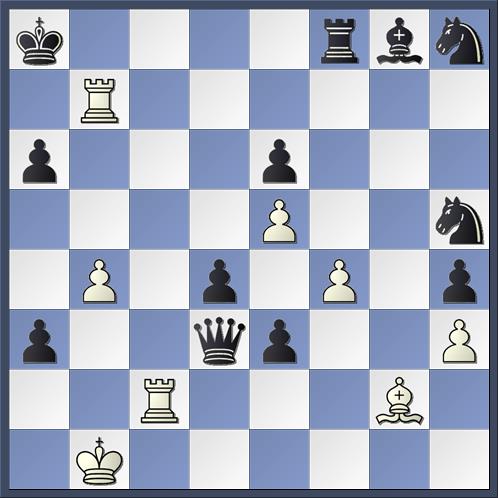
My Christmas Puzzle for year 2024:

Árpád Rusz
White wins

1. Rh4! 1. Rh1+? skewer Kc2 2. Rxa1 Kb2 3. Rh1 Kxa3 4. Rb1 Ka2 5. Rb8 a3 6. Kf3 Ka1 7. Ke3 a2 8. Kd3 stalemate 1... Kc2 2. Rxa4 Kb3 3. Ra8! Nc2 4. a4 Nb4! Now it is time to approach with the white king. 4... Kb4 5. a5 Kb5 6. a6 Kb6 7. a7 Kb7 8. Rc8! +-

5. Kh4!!

There is only one exit from the corner area for the white king! 5. Kg4? Nc6 6. Ra6 Ne5+ 7. Kf5 Nc4 =; 5. Kf4? Nc6! 6. Ra6 Nb4 7. Ra5 Nc6 8. Rc5 Nb4 9. a5 Nd3+ 10. Ke3 Nxc5 =; 5. a5? Ka4 6. a6 Ka5 7. a7 Nc6 =; 5. Kg2?! Nc6 6. Ra6 Nb4 7. Ra5 Na2 8. Ra8 Nb4 9. Kf1 Nc6 10. Ra6 Nb4 11. Ra5 Na2 12. Ra8 Nb4 13. Ke1? (13. Ke2? Nc6 14. Ra6 Nb4 15. Ra5 Na2 16. Ra8 Nc3+ =) 13... Nc6 14. Ra6 Nb4 15. Ra5 Nc6! 16. Rc5 Nb4 17. a5 Nd3+ = 5... Nc6 6. Ra6 Nb4 7. Ra5 Na2! 7... Nc2 8. Rc5 (8. Ra8? Kb4 9. a5 Kb5 10. a6 Kb6 11. a7 Na3! 12. Rb8+ Kxa7 13. Rb4 Nc2 =) 8... Nb4 9. a5 +- 8. Ra8! Kb4 8... Nb4 9. Kg5 Nc6 10. Ra6 Nb4 11. Ra5 Nc6 12. Rc5 Nd4 13. Rd5 (13. a5? Ne6+ 14. Kf6 Nxc5 =) 13... Kc4 14. Rd6 Nb3 15. Rb6 Nc5 16. a5 +- 9. a5 Kb5 10. a6 Kb6 11. Rc8! Ka7 11... Kxa6 12. Ra8+ +- skewer 12. Rc4! Kxa6 13. Ra4+ +-

Watch this study on a dynamic board.

Monday, 23 October 2017

Study 93

Árpád Rusz
Marwitz-100 MT, 2016
Special Prize
- version -

White wins

Now I prefer this more economical initial position of Study 93a. The main line and the two tries all feature different systematic movements!

1st try: 1.f8Q? Ra7+ 2.Kb8 Rab7+! 2...Rhb7+? 3.Kc8 Rc7+ 4.Kd8 Rd7+ 5.Ke8 Re7+ 6.Qxe7+– 3.Kc8 Rbc7+ 4.Kd8 Rcd7+ 5.Ke8 Rde7+ 6.Qxe7 Rxh8+ 7.Kd7 h2 8.Qf7+ Kb1 9.Qb3+ Kc1= 9...Ka1? 10.Qc3++–

2nd try: 1.Qxg7? Rxg7 2.f8Q h2! 3.Qxf3

3...Rg8+!! Paradoxically, black lets the white king to escape from the eight rank! The immediate 3...Rg1? loses because of a Queen staircase on the a and b-files from b3 to b8! 4.Qb3+ Ka1 5.Qa3+ Kb1 6.Qb4+ Ka1 7.Qa5+ Kb1 8.Qb6+ Ka1 9.Qa7+ Kb1 10.Qb8++– 4.Kb7 Rg1! Another check would be fatal: 4...Rg7+? 5.Kc8!! Back to the 8th rank! (5.Kc6? Rg1 6.Qb3+ Ka1 7.Qa3+ Kb1 8.Qb4+ Ka1 9.Qa5+ Kb1 10.Qb6+ Kc1!=) 5...Rg8+ 6.Kd7!+– 5.Qb3+ Ka1 6.Qa3+ Kb1 7.Qb4+ Ka1(2) 8.Qa5+ Kb1 9.Qb6+ Ka1(2) 10.Qa7+ Kb1(2)=

Main: 1.Qxh7! Rxh7

2.f8Q f2! 2...h2 6.Qg8++– 3.Qxf2 3.Qg8+? Ka1! 4.Qxh7 f1Q=; 3.c4? Rh8! 4.Qxh8 f1Q= 3...h2 4.c4+ Kb3 5.Qf3+ Kb4! 5...Kxc4 6.Qe4++– 6.Qh1 Kc5!

The plan that looks logical now is starting to move with the white king towards the rook. But it doesn't work yet! While the black king is on c5 the rook can leave the seventh rank (e.g. by moving to h5). 7.Qd5+ Kb4 8.Qd2+ Kc5 9.Qf2+ Kb4 10.Qb2+ Kc5 11.Qb5+ Kd4 12.Qd5+ Kc3 13.Qh1 Kd4 The black king is not on c5 so the white king can make a move towards the rook! 14.Kb8! The first step. 14...Kc5 Back to c5... White needs to repeat the manoeuvre to gain a tempo for another king move.

15.Qd5+ Kb4 16.Qd2+ Kc5 17.Qf2+ Kb4 18.Qb2+ Kc5 19.Qb5+ Kd4 20.Qd5+ Kc3 21.Qh1 Kd4 22.Kc8! The second step. 22...Kc5

23.Qd5+ Kb4 24.Qd2+ Kc5 25.Qf2+ Kb4 26.Qb2+ Kc5 27.Qb5+ Kd4 28.Qd5+ Kc3 29.Qh1 Kd4 30.Kd8! The third step. 30...Kc5

31.Qd5+ Kb4 32.Qd2+ Kc5 33.Qf2+ Kb4 34.Qb2+ Kc5 35.Qb5+ Kd4 36.Qd5+ Kc3 37.Qh1 Kd4 38.Ke8! The fourth step. 38...Kc5

39.Qd5+ Kb4 40.Qd2+ Kc5 41.Qf2+ Kb4 42.Qb2+ Kc5 43.Qb5+ Kd4 44.Qd5+ Kc3 45.Qh1 Kd4 46.Kf8! The fifth step. 46...Kc5

47.Qd5+ Kb4 48.Qd2+ Kc5 49.Qf2+ Kb4 50.Qb2+ Kc5 51.Qb5+ Kd4 52.Qd5+ Kc3 53.Qh1 Kd4 54.Kg8! +- The last step along the 8th rank.

The white king will finally escape from the last rank. White has a winning position. Notice that this was the 50th move since the last capture or pawn move (4.c4+), so according to the FIDE rules, this position would be a draw! Fortunately, endgame study composition codex doesn't care about that artificial "draw by 50 moves" rule!

Watch this study on a dynamic board! Click here!

Saturday, 11 June 2016

Study 93a

Árpád Rusz
Marwitz-100 MT, 2016
Special Prize
- version -

White wins

1.Rxa3+! 1.Qxh7? Rg5 2.Rxa3+ Qxa3+ 3.Kb7 Rb5+=; 1.f8Q? Qa5+ 2.Kb7 Qb5+ 3.Ka7 Qa5+ perpetual check 1...Qxa3+ 1...Kxa3 2.Qxh7 Rg5 3.Qd3++– 2.Kb8! 2.Kb7? Rgxg7 3.Rxa3+ Kxa3–+ 2...Qxa8+ 3.Kxa8 Rgxg7! Capturing the Queen leads to two echo positions: 3...Rxh8+ 4.Bxh8 h2 5.f8Q h1Q 6.Qf7+ Kb1 7.Qb3+ Kc1 8.Qb2+ Kd2 9.Qc3+ Ke2 (9...Kd1 10.Qa1++– echo position 1)

10.Qd3+ Ke1 11.Bc3+ Kf2 12.Qd2+ Kg3 13.Be5+ Kg4 14.Qf4+ Kh5 15.Qf5+ Kh6 16.Qf6+ Kh5 17.Qh8++– echo position 2

So back to the main line after black’s third move we have the following critical position on the board:

This could be a more economical starting position of the study. The main line and the two tries all feature different systematic movements!
Try1: 4.f8Q? Ra7+ 5.Kb8 Rab7+! (5...Rhb7+? 6.Kc8 Rc7+ 7.Kd8 Rd7+ 8.Ke8 Re7+ 9.Qxe7+–) 6.Kc8 Rbc7+ 7.Kd8 Rcd7+ 8.Ke8 Rde7+ 9.Qxe7 Rxh8+ 10.Kd7 h2 11.Qf7+ Kb1 12.Qb3+ Kc1= (12...Ka1? 13.Qc3++–);
Try2: 4.Qxg7? Rxg7 5.f8Q h2! (5...Rg3? 6.Qh6! Kb2 (6...f2 7.Qe6+ Kb1 8.Qb6++–) 7.Qd2!+–) 6.Qxf3

6...Rg8+!! Paradoxically, black lets the white king to escape from the eight rank! (The immediate 6...Rg1? loses because of a Queen staircase on the a and b-files from b3 to b8! 7.Qb3+ Ka1 8.Qa3+ Kb1 9.Qb4+ Ka1 10.Qa5+ Kb1 11.Qb6+ Ka1 12.Qa7+ Kb1 13.Qb8++– ) 7.Kb7 Rg1! (7...Rg7+? 8.Kc8!! Back to the eight rank! (8.Kc6? Rg1 9.Qb3+ Ka1 10.Qa3+ Kb1 11.Qb4+ Ka1 12.Qa5+ Kb1 13.Qb6+ Kc1!=) 8...Rg8+ 9.Kd7!+–) 8.Qb3+ Ka1 9.Qa3+ Kb1 10.Qb4+ Ka1(2) 11.Qa5+ Kb1 12.Qb6+ Ka1(2) 13.Qa7+ Kb1(2)=
Main: 4.Qxh7! It is a paradox that white captures the rook only after black managed to protect it.4...Rxh7

This could be an even more economical starting position. My feeling is that a lot would be lost with this simplification. 5.f8Q f2! 5...h2 6.Qg8++– 6.Qxf2 6.Qg8+? Ka1! 7.Qxh7 f1Q=; 6.c4? Rh8! 7.Qxh8 f1Q= 6...h2 7.c4+ Kb3 8.Qf3+ Kb4! 8...Kxc4 9.Qe4++– 9.Qh1 Kc5!

The plan that looks logical now is starting to move with the white king towards the rook. But it doesn't work yet! While the black king is on c5 the rook can leave the seventh rank (e.g. by moving to h5). 10.Qd5+ Kb4 11.Qd2+ Kc5 12.Qf2+ Kb4 13.Qb2+ Kc5 14.Qb5+ Kd4 15.Qd5+ Kc3 16.Qh1 Kd4 The black king is not on c5 so the white king can make a move towards the rook! 17.Kb8! The first step. 17...Kc5 Back to c5... White needs to repeat the manoeuvre to gain a tempo for another king move.

18.Qd5+ Kb4 19.Qd2+ Kc5 20.Qf2+ Kb4 21.Qb2+ Kc5 22.Qb5+ Kd4 23.Qd5+ Kc3 24.Qh1 Kd4 25.Kc8! The second step. 25...Kc5

26.Qd5+ Kb4 27.Qd2+ Kc5 28.Qf2+ Kb4 29.Qb2+ Kc5 30.Qb5+ Kd4 31.Qd5+ Kc3 32.Qh1 Kd4 33.Kd8! The third step. 33...Kc5

34.Qd5+ Kb4 35.Qd2+ Kc5 36.Qf2+ Kb4 37.Qb2+ Kc5 38.Qb5+ Kd4 39.Qd5+ Kc3 40.Qh1 Kd4 41.Ke8! The fourth step. 41...Kc5

42.Qd5+ Kb4 43.Qd2+ Kc5 44.Qf2+ Kb4 45.Qb2+ Kc5 46.Qb5+ Kd4 47.Qd5+ Kc3 48.Qh1 Kd4 49.Kf8! The fifth step. 49...Kc5

50.Qd5+ Kb4 51.Qd2+ Kc5 52.Qf2+ Kb4 53.Qb2+ Kc5 54.Qb5+ Kd4 55.Qd5+ Kc3 56.Qh1 Kd4 57.Kg8! +- The last step along the eight file.

The white king will finally escape from the last rank. White has a winning position. Notice that this was the 50th move since the last capture or pawn move (7.c4+), so according to the FIDE rules, this position would be a draw! Fortunately, endgame study composition codex doesn't care about that artificial "draw by 50 moves" rule!

Watch this study on a dynamic board! Click here!

Related study: Study 93.

Friday, 10 June 2016

Study 86

Árpád Rusz
3rd UAPA Ty
2015

White wins

1. Bg2!! Qxd3+ 1... Nxf4 2. Rxa6+ Kb8 3. Rcb6+ Kc8 (3... Kc7 4. Rb7+ Kc8 5. Ra8#) 4. Ra8+ Kc7 5. Rb7#; 1... Qb7 2. Rxb7 Kxb7 3. Nc5+ Kb8 4. Nd7+ +- 2. Rc2+! 2. Ka1? Qf1+! 3. Bxf1 Nxf4 = 2...Ka7 3. Rb7+ Ka8

White wins by a complex windmill mechanism:
4. Rf7+ Kb8 5. Rxf8+ Ka7 6. Ra8+ Kb6 7. Rb8+ Ka7 8. Rb7+ Ka8

9. Rg7+ Kb8 10. Rxg8+ Ka7 11. Ra8+ Kb6 12. Rb8+ Ka7 13. Rb7+ Ka8

14. Rh7+ Kb8 15. Rxh8+ Ka7 16. Ra8+ Kb6 17. Rb8+ Ka7 18. Rb7+ Ka8

19. Kc1! Qxc2+ 20. Kxc2 d3+! 21. Kc3! 21. Kxd3? Nxf4+ -+ 21... a2 21... Nxf4 22. Bf3 Nd5+ 23. Bxd5 exd5 24. Rg7 +- 22. Rb5+! Ka7 23. Ra5 Nxf4 24. Bf3! e2 25. Kd2 +-

Watch this study on a dynamic board! Click here!

Monday, 30 May 2016

After an 8 years break, I am back to my blog! First I would like to present a new version of the most complex study I have composed. I order to win, white needs 57 precise moves along the main line!

Árpád Rusz
Marwitz-100 MT, 2016
Special Prize
- version -

White wins

1.Rxa3+! 1.Qxh7? Rg5 2.Rxa3+ Qxa3+ 3.Kb7 Rb5+=; 1.f8Q? Qa5+ 2.Kb7 Qb5+ 3.Ka7 Qa5+ perpetual check 1...Qxa3+ 1...Kxa3 2.Qxh7 Rg5 3.Qd3++– 2.Kb8! 2.Kb7? Rgxg7 3.Rxa3+ Kxa3–+ 2...Qxa8+ 3.Kxa8 Rgxg7! Capturing the Queen leads to two echo positions: 3...Rxh8+ 4.Bxh8 h2 5.f8Q h1Q 6.Qf7+ Kb1 7.Qb3+ Kc1 8.Qb2+ Kd2 9.Qc3+ Ke2 (9...Kd1 10.Qa1++– echo position 1)

10.Qd3+ Ke1 11.Bc3+ Kf2 12.Qd2+ Kg3 13.Be5+ Kg4 14.Qf4+ Kh5 15.Qf5+ Kh6 16.Qf6+ Kh5 17.Qh8++– echo position 2

So back to the main line after black’s third move we have the following critical position on the board:

This could be a more economical starting position of the study. The main line and the two tries all feature different systematic movements!
Try1: 4.f8Q? Ra7+ 5.Kb8 Rab7+! (5...Rhb7+? 6.Kc8 Rc7+ 7.Kd8 Rd7+ 8.Ke8 Re7+ 9.Qxe7+–) 6.Kc8 Rbc7+ 7.Kd8 Rcd7+ 8.Ke8 Rde7+ 9.Qxe7 Rxh8+ 10.Kd7 h2 11.Qf7+ Kb1 12.Qb3+ Kc1= (12...Ka1? 13.Qc3++–);
Try2: 4.Qxg7? Rxg7 5.f8Q h2! (5...Rg3? 6.Qh6! Kb2 (6...f2 7.Qe6+ Kb1 8.Qb6++–) 7.Qd2!+–) 6.Qxf3

6...Rg8+!! Paradoxically, black lets the white king to escape from the eight rank! (The immediate 6...Rg1? loses because of a Queen staircase on the a and b-files from b3 to b8! 7.Qb3+ Ka1 8.Qa3+ Kb1 9.Qb4+ Ka1 10.Qa5+ Kb1 11.Qb6+ Ka1 12.Qa7+ Kb1 13.Qb8++– ) 7.Kb7 Rg1! (7...Rg7+? 8.Kc8!! Back to the eight rank! (8.Kc6? Rg1 9.Qb3+ Ka1 10.Qa3+ Kb1 11.Qb4+ Ka1 12.Qa5+ Kb1 13.Qb6+ Kc1!=) 8...Rg8+ 9.Kd7!+–) 8.Qb3+ Ka1 9.Qa3+ Kb1 10.Qb4+ Ka1(2) 11.Qa5+ Kb1 12.Qb6+ Ka1(2) 13.Qa7+ Kb1(2)=
Main: 4.Qxh7! It is a paradox that white captures the rook only after black managed to protect it.4...Rxh7

This could be an even more economical starting position. My feeling is that a lot would be lost with this simplification. 5.f8Q f2! 5...h2 6.Qg8++– 6.Qxf2 6.Qg8+? Ka1! 7.Qxh7 f1Q=; 6.c4? Rh8! 7.Qxh8 f1Q= 6...h2 7.c4+ Kb3 8.Qf3+ Kb4! 8...Kxc4 9.Qe4++– 9.Qh1 Kc5!

The plan that looks logical now is starting to move with the white king towards the rook. But it doesn't work yet! While the black king is on c5 the rook can leave the seventh rank (e.g. by moving to h5). 10.Qd5+ Kb4 11.Qd2+ Kc5 12.Qf2+ Kb4 13.Qb2+ Kc5 14.Qb5+ Kd4 15.Qd5+ Kc3 16.Qh1 Kd4 The black king is not on c5 so the white king can make a move towards the rook! 17.Kb8! The first step. 17...Kc5 Back to c5... White needs to repeat the manoeuvre to gain a tempo for another king move.

18.Qd5+ Kb4 19.Qd2+ Kc5 20.Qf2+ Kb4 21.Qb2+ Kc5 22.Qb5+ Kd4 23.Qd5+ Kc3 24.Qh1 Kd4 25.Kc8! The second step. 25...Kc5

26.Qd5+ Kb4 27.Qd2+ Kc5 28.Qf2+ Kb4 29.Qb2+ Kc5 30.Qb5+ Kd4 31.Qd5+ Kc3 32.Qh1 Kd4 33.Kd8! The third step. 33...Kc5

34.Qd5+ Kb4 35.Qd2+ Kc5 36.Qf2+ Kb4 37.Qb2+ Kc5 38.Qb5+ Kd4 39.Qd5+ Kc3 40.Qh1 Kd4 41.Ke8! The fourth step. 41...Kc5

42.Qd5+ Kb4 43.Qd2+ Kc5 44.Qf2+ Kb4 45.Qb2+ Kc5 46.Qb5+ Kd4 47.Qd5+ Kc3 48.Qh1 Kd4 49.Kf8! The fifth step. 49...Kc5

50.Qd5+ Kb4 51.Qd2+ Kc5 52.Qf2+ Kb4 53.Qb2+ Kc5 54.Qb5+ Kd4 55.Qd5+ Kc3 56.Qh1 Kd4 57.Kg8! +- The last step along the eight file.

The white king will finally escape from the last rank. White has a winning position. Notice that this was the 50th move since the last capture or pawn move (7.c4+), so according to the FIDE rules, this position would be a draw! Fortunately, endgame study composition codex doesn't care about that artificial "draw by 50 moves" rule!