Showing posts with label Rundlauf. Show all posts

Thursday, 28 September 2023

Study 190

Árpád Rusz
Chess Study Art
2023
- version -
Draw

Watch this study on a dynamic board! Click here!

You can analyze the study with the help of the Syzygy tablebases here.

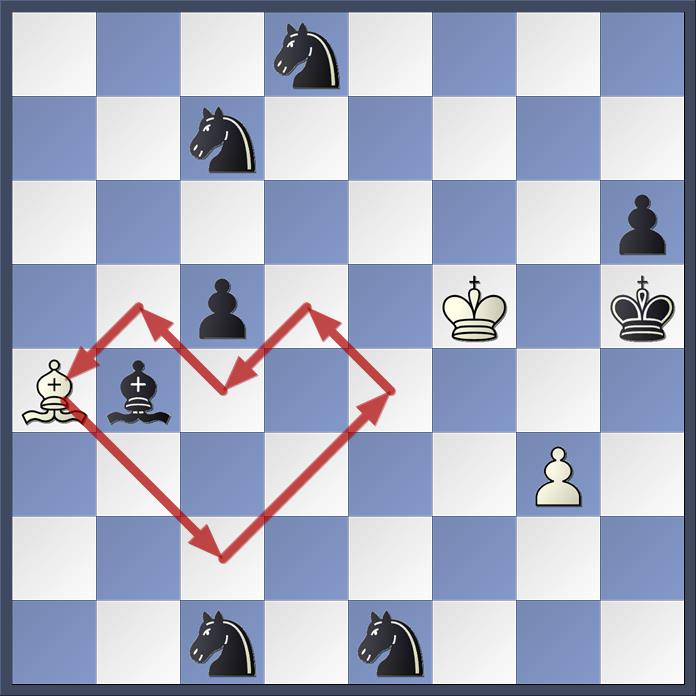
1. Kc2! 1. Bh3? Ng8! -+ 1... Kb4 1... Ng4 2. Kc3 c5 3. Bg2 d4+ (3... Ne3 4. Bxd5! Nxd5 5. Kc4 =) 4. Kc4! Ne3+ 5. Kxc5 Nxg2 6. Kxd4 = 2. a3+! Kc5 2... Kxa3 3. Kc3 Nf5 4. Bh3 Ne7 5. Bd7! c6 6. Kd4 Kb4 7. Bxc6! Nxc6+ 8. Kxd5 = 3. Kb3! White is preparing to advance the a-pawn. 3. Kc3? Nf5 4. a4 Ng3! 5. Bd3 Ne4+ Avoiding this check is the reason why white should choose 3. Kb3 instead of 3. Kc3. 4. Kb3 Kb6! 5. Kb4 c5+ -+ Black gets a winning position after managing to achieve both of its strategic goals (stopping the white pawn and pushing the c-pawn to c5). 3... Nf5 4. a4 Nd4+ Here the check comes even one move earlier than in the previous try, but the knight is in an awkward position on d4. 4... Ng3 5. Bd3 Ne4 There is no check, therefore the white pawn can advance. 6. a5 = 5. Kc3 Nc6 Black stops the white pawn but simultaneously blocks its own c-pawn by two pieces... 6. Be2! 6. Bd3? d4+ 7. Kb3 Na5+ -+ 6... Na5 6... d4+ 7. Kc(d)2! (7. Kd3? Nb4+ 8. Ke4 Nd5 -+) 7... Kb4 8. Kd3 =

7. Bh5!!

7. Bb5? d4+ (7... c6? 8. Be2! zz d4+ 9. Kd3 Nc4 10. Ke4 =) 8. Kd3 c6 9. Ba6 Kd5 -+

mutual zugzwang

7... Nc4 7... Kd6 8. Kb4 =; 7... d4+ 8. Kd3 Nc6 9. Ke4 = 8. Be8! It is important for white to defend its pawn. 8. Be2? d4+ 9. Kd3 Nb2+ -+

mutual zugzwang

8... Ne5! Black lets the a-pawn run, planning to block it later. The knight has a dominating position in the center of the board leaving only a few safe squares for the bishop. 8... d4+ 9. Kd3 Nb2+ A fork but fortunately, the white pawn is defended. (9... Ne5+ With the bishop on d7 instead of e8, white would now lose. 10. Ke4 =) 10. Kc2 Nc4 11. Kd3 c6 12. Kc2! (12. Ke4? Nd6+ -+) 12... Ne5 13. Kb3 Nc4 14. Kc2 Na5 15. Kd3 Nc4 16. Kc2 positional draw; 8... c6 9. Kb3! zz Kd4!? (9... Kb6 10. Bf7 =; 9... Kd6 10. Kb4 c5+ 11. Kb5 =) 10. a5! = (10. Bxc6? Na5+ -+); 8... Nd6 9. Bg6! (9. Bh5? c6! 10. Bg6 Nc4 11. Bf7 d4+ -+) 9... c6 10. Bh7! Nc4 11. Bg8! d4+ 12. Kc2! Kb4 13. Kd3 = 9. Bb5! 9. a5? Nc6 10. a6 (10. Bxc6 Kxc6 11. Kd4 Kd6 12. a6 c5+ -+) 10... Na7 11. Bd7 (11. Bh5 Nb5+ -+) 11... c6 -+; 9. Bh5? d4+ 10. Kb3 Nc4 11. Be2 Na5+ -+

mutual zugzwang

9... Nc6 9... d4+ 10. Kb3 The bishop is ideally placed attacking both c4 and c6. 10... Nc6 11. Bxc6 Kxc6 12. Kc4 = 10. Be2! Thematic try: 10. Bf1? Na5 11. Be2 c6! zz 12. Bh5 Nc4 13. Be8 Ne5! zz. Now the bishop cannot continue the merry-go-round anymore and has to return. Unlike in the main line, here it is not possible to attack the c4 square by Bb5 because of the line-interfering c6 pawn. 14. Bh5 d4+ 15. Kb3 Nc4 16. Be2 Na5+ 17. Ka3 Kb6 18. Kb4 c5+ -+

mutual zugzwang

10... Na5 11. Bh5! positional draw on 4 pairs of knight/bishop corresponding squares

Both the knight and the bishop moves along diamond-shape paths on the board:

There was even a third Rundlauf in the first version of the study!

Árpád Rusz
Chess Study Art
2023
Draw

1. Kb2! Kc5 2. Kc3 d5 3. Bf7! Nd6 4. Bg6! with two variations:

a) 4... Nc4 5. Be8! zz Ne5 6. Bb5! zz Nc6 7. Be2! zz Na5 8. Bh5!! zz Nc4 9. Be8 positional draw

b) 4... c6 5. Bh7! Thematic try: 5. Bh5? Nc4 6. Be2 d4+ 7. Kc2 Kb4 8. Kd3 c5 -+ 5... Nc4 6. Bg8! Rundlauf

6... d4+ 7. Kc2! Kb4 8. Kd3 c5 9. Bxc4 =

Monday, 3 September 2018

Study 152

Árpád Rusz
RCS blog
2018

White wins

1. g4! 1st knight sacrifice 1... hxg3 e.p. 1... Bxe4 2. a6 +- 2. Nxg3+ Kg2

3. Nh1!! 2nd knight sacrifice 3. Nh5? Bc4! (3... Kxh3? 4. Nf4+ +- echo) 4. h4 Kh3 = 3... Be2 3... Kxh3 4. Nf2+ +- echo; 3... Kxh1 4. h4 Kg2 5. h5 Kf3 6. h6 Kf4 7. a6! Kg5 8. a7 +- 4. h4 Kh3! 4... Kxh1 5. Ke7 Kg2 6. Kf6 Kg3 7. Kg5 +- 5. h5! Bxh5 6. Nf2+ Kg3 7. Ne4+


Rundlauf

7... Kf4 8. a6! 3rd knight sacrifice 8... Kxe4 9. a7 +-

Watch this study on a dynamic board! Click here!

Thursday, 18 January 2018

Study 144

Árpád Rusz
The Problemist
2018

Draw

1. Bxd7! 1. Nc5+? Kd5 2. Nxd7 Nxd6 3. Nf6+ Kc5! 4. Nd7+ Bxd7 5. Bxd7 Position X' 5... d3 -+ 1... Bxd7 2. Nc5+ The knight leaves the b3 square, but it will return there after a long trip. 2... Kd5 3. Nxd7 Nxd6 3... Kxd6 4. Nb6 d3 5. Nc4+ Kc5 6. Nd2 = 4. Nf6+! 4. Nb6+? Kc6 -+ 4... Ke6 4... Kc5 5. Nd7+ Position X - The knight proves to be more efficient than the bishop in the fight against the passed pawn. 5... Kd5 (5... Kc6 6. Ne5+ Kd5 7. Nd3 =) 6. Nf6+ Kc5 (6... Kc4 7. Ng4 d3 8. Ne5+ =) 7. Nd7+ perpetual check 5. Nh5! This extra file was missing from the other flank. 5... Kf5 5... d3 6. Nf4+ = 6. Ng3+ Kg4 7. Nf1! The knight has to stop the pawn before it reaches d2. 7. Ne2? d3 8. Nc3 d2 -+ 7... Kf3 8. Nd2+ Ke2 9. Nb3! = During the trip, the knight drew a big square on the board!

Watch this study on a dynamic board! Click here!

Wednesday, 10 May 2017

Study 114

Árpád Rusz
RCS blog
2017
after Gijs van Breukelen

White wins

This is my version of a really famous study (see for example this link.). I have added a thematic try and a heart-shaped Rundlauf, but the core of the study, of course, belongs to Gijs van Breukelen.

1. Nh5+!! Thematic try: 1. Ne6+? Kg6 2. Bc2+ Kh5 3. d8=Q Nf7+ and it is a draw because the e6 square is blocked by the harmful white knight! 1... Kg6 2. Bc2+! Kxh5 2... Kf7 3.d8=Q +- 3. d8=Q Nf7+ 4. Ke6! The e6 square was empty! 4...Nxd8+ 5. Kf5 e2 6. Be4 e1=N! 6... e1=Q 7. Bf3# 7. Bd5! c2 8. Bc4 c1=N! 9. Bb5 Nc7 10. Ba4! +-

Watch this study on a dynamic board! Click here!

Tuesday, 2 May 2017

Study 112

Árpád Rusz
5th FIDE World Cup
2017
2nd Commendation

Draw

In the initial position there is a pawn battery but unfortunately it is blocked by the black queen. Therefore, the white queen leaves the a1 square but not without saying: "I'll be back!" 1. Qg1+ Ke4! Black is trying to avoid the capture of the white pawn. 2. Qg4+! Kd5 2... Kxe5 3. Nc4+ +- 3. Qd7+ Kxe5 3... Ke4 4. Qg4+ perpetual check 4. Qxa7! Only now is possible to take that knight, after the black king has moved to e5. 4... a1=Q 4... Qd1+ 5. Ke8! = 5. Nc4+! White fires the knight battery. This check was the reason why black tried to avoid capturing the e5-pawn. 5... Qxc4 6. Qxa1 The queen returns to a1 and rebuilds the pawn battery which, unlike in the initial position, is not blocked anymore.


Rundlauf

6... f5! Black is not afraid of the white battery!


refusal to attack

7. b4+!! White refuses to attack the black queen! Thematic try: 7. b3+? Qd4+ 8. Qxd4+ Kxd4 -+ 7... Qd4+ 8. Qxd4+ Kxd4 9. Kc7! White is starting a Réti manoeuvre to catch the black pawn! 9. b5? Kc5 10. Kc7 Kxb5 11. Kd6 f4 -+; 9. Kd7? f4 10. b5 Kc5 -+ 9... Kc4 9... f4 10. b5 f3 11. b6 f2 12. b7 f1=Q 13. b8=Q = 10. Kc6! Kxb4 10... f4 11. b5 = 11. Kd5 = Done!

Watch this study on a dynamic board! Click here!

Saturday, 11 June 2016

Study 92

Árpád Rusz
Afek-64 JT
2016
3rd Honourable Mention

White wins

1. Qf3! Bg7+ 2. Kxd5 Nc3+! 3. Qxc3 Qd7+ 4. Kc4! Thematic try: 4. Kxc5? Bxd4+ 5. Qxd4 Qa7+ 6. Kc4 Qxa4+ 7. Kc3 Qa1+ 8. Kd3 Qd1+ 9. Ke3 Qg1+ 10. Ke4 Qg4+ 11. Ke5 Qg7+ 12. Kd5 Qd7+ 13. Kc5 Qa7+ perpetual check


perpetual check

Loss of time: 4. Ke4 Qg4+ 5. Kd3 Qd1+ 6. Kc4 Qxa4+ 4... Qxa4+ 5. Kd5! 5. Kxc5? Bxd4+ 6. Kd6+!? Bxc3 7. Rxc3+ Kb7 = (7... Kb8? 8. Rh8+ Kb7 9. Rc7+ Kb6 10. Rb8+ Ka6 11. Ra8+ +-; 7... Kd8? 8. Rh8+ +-) 5... Qd7+ 6. Kxc5! Bxd4+

7. Kb4+!! Bxc3+ 8. Rxc3+ Kb7 9. Rb5+ Ka6 10. Ra3# The mate is possible only because the harmful a-pawn has disappeared.

Watch this study on a dynamic board! Click here!

Friday, 10 June 2016

Study 83

Árpád Rusz
2nd UAPA Ty
2015

Draw

1.Qxh5! 1.Qxd5? Ng3#; 1.Rxb2? Ng3+ 2.Kxh2 Be4+ -+

First main line:1...Be4+ 2.Nxe4 Qxh5


perpetual check by two rooks

3.Ra5+! Thematic try: 3.Rd8+? Ka7 4.Ra5+ Kb6 5.Rd6+ Kxa5 6.Rxd5+ Rb5! -+ 3...Kb8 4.Rd8+ Kc7 5.Rc5+! Kb6 5...Kxd8 6.Rxd5+! Qxd5 stalemate 6.Rd6+ Ka7 7.Ra5+ Kb8 8.Rd8+ Kc7 9.Rc5+ =

Second main line: 1...Rxb5 2.Rxh7! Qxc3 3.Qe8+ fork Ka7 4.Qxb5 Qc1+ 5.Kxh2 Qc2+ fork 6.Kg1 Qxh7


perpetual check by the queen

7.Qa5+! Kb8 8.Qd8+! Ka7 9.Qa5+ =

Watch this study on a dynamic board! Click here!

Study 79

Árpád Rusz
2nd UAPA Ty
2015
Special Prize
- after J. Bryant -

White wins

1.Kc5+! 1.Kd5+? Nf6+ 2.Ke6 hxg6 3.Bxf6+ Kh7 4.Bd4 gxh5 5.gxh5 Kg8 6.Kd7! catching the N 6...Kf7! 7.Kxc8 Ke6 8.Bg7 Kf5 9.Bxh6 Kg4!= 1...Nf6 2.gxh7 Kh8!! Triangulation 2...Kxh7 3.Bxf6 Kg8 4.Bd4 Ne7 5.Be3 Kg7 6.Kd6 Ng6 (6...Ng8 7.Ke6+–) 7.hxg6 Kxg6 8.Ke5 h5 9.g5+– 3.Bxf6+ 3.Kb4? Kxh7 (3...Nd6? 4.Bxf6+ Kxh7 5.Bd4+–) 4.Bxf6 Kg8=; 3.Kc6? Ne7+ 4.Kd6 Ned5=; 3.Be5?! Kg7 waste of time] 3...Kxh7 White needs to reach to same position but with BTM. The cycle to achieve this is 36 moves long!! That is a record. Surprisingly, this manoeuvre is almost free of duals (except time wasting duals, the only time when there is an alternative way for a few moves is at move 6 but that also leads to the main line some moves later).


Cyclic zugzwang - WTM

4.Bd4 Ne7 5.Kd6 Ng6!


Position A

5...Nc8+ 6.Kd7+– catching the N; 5...Ng8 6.Ke6+– zugzwang 6.Be5 [minor dual 6.Be3 Nh4 7.Ke5 Nf3+ 8.Ke4 Ne1 9.Bd2 Nc2 10.Kd3 Na3 11.Bf4 Nb5 12.Kc4 Na3+ 13.Kb4 Nc2+ 14.Kc3 Ne1 15.Kd2 etc. as in the main line; 6.hxg6+? Kxg6 7.Be3 h5=] 6...Nh4 7.Kd5 Nf3 8.Bf4 Ne1 9.Kc4 Kg7 10.Kd4! Kh7 11.Kc3 Ng2 12.Bd2 Nh4 13.Kd3 Nf3 14.Bf4 Ne1+ 15.Kd2 Nf3+ 16.Ke3 Ne1


Position B

17.Bg3 Nc2+ 18.Kd3 Nb4+ 19.Kc4 Nc6 20.Kc5 Na5 21.Bf4 Kg7 22.Kb6 Nc4+ 23.Kb5 Na3+ 24.Kb4 Nc2+ 25.Kc3 Ne1 26.Kd2 Nf3+ 27.Ke3 Ne1


Position B'

28.Be5+ Kg8 29.Bc3 Nc2+ 30.Kd3 Na3 31.Be5 Kf7 32.Bf4 Kg7 33.Kc3 Kh7 34.Be5 Nb1+ 35.Kc2 Na3+ 36.Kb3 Nb5 37.Kb4 Na7 38.Kc5 Nc8 39.Bf6


Cyclic zugzwang - BTM

39...Kg8 40.Bd4! Ne7 41.Be3 Kh7 41...Kg7 42.Kd6 Ng8 43.Ke6+– 42.Kd6 Ng6! 42...Nc8+ 43.Kd7+–


Position A'

43.hxg6+ Kxg6 44.Ke5 h5 45.g5 +- This analysis uses the term "Cyclic Zugzwang" which is the generalization of the common 3–move (or 5 ply) long triangulation to pass the move to the weaker side. If the stronger side is to move in a "cyclic zugzwang" position, it wins more slowly than with the other side to move, and in order to win, the stronger side can be forced to visit the same position but with the other side to move. The key position for this study was discovered by John Bryant (see https://www.youtube.com/watch?v=2h_b0puS8Vk). I conjectured that this position is a genuine cyclic zugzwang (not only the shortest path but all paths to win must go through the BTM position) and that later was proved to be true by some specially modified Freezer and FinalGen softwares.

Watch this study on a dynamic board! Click here!

Monday, 6 June 2016

Study 73

Árpád Rusz
Magyar Sakkvilág
2013
- version -

White wins

1. Kf5! 1. g4? Ng6+ = 1... Kf2 2. g4 Kg3 3. g5 Kh4 4. Kf6 Kg4! 5. Ne6 Kh5


cyclic zugzwang - WTM

6. Ng7+ The start of a Rundlauf manoeuvre by the wN 6. Kg7? Ng6 = 6... Kh4 7. Nf5+ Kg4 7... Kh5 8. Ng3+ Kg4 9. Ne4 Kh5 10. Kf5 Kh4 11. Nf6 Kh3 12. Ng4 Nf7 13. g6 Nd6+ 14. Ke6 Ne8 15. Kf7 Nd6+ 16. Kf8 Nf5 17. Ne3! +- 8. Nd4 Kh5 8... Kh4 9. Nf3+ Kg4 10. Kg7! +- 9. Ne6! We have reached the same position but with black to move!


cyclic zugzwang - BTM

9...Ng6 9... Kh4 10. Kg7 +- 10. Ng7+ Kg4 11. Kxg6 +-

Watch this study on a dynamic board! Click here!

Related study: Study 150

Study 72

Árpád Rusz
Fritz-100 MT
2012
2nd Prize

White wins

Thematic try: 1. h5? e3 2. Ne2 Nd3 3. Ng3 Nf2 4. Kf4 Nd3+ 5. Ke4 Nc5+ 6. Ke5 Nd3+ 7. Kf6 7. Kf5 Nf2 positional draw - Rundlauf by the wK 7... e2! 8. Nxe2 Nf4! mutual zugzwang


WTM

9. Ng3 9. Nxf4 stalemate 9... Nxg6! 10. hxg6 stalemate.

Solution: 1. Nh5!! e3 1... Nb7 2. g7 Kh7 3. Kxe4 Nd6+ 4. Ke5 Ne8 5. Nf6+ +- 2. Ng3 Ne6! 3. Kf6! 3. Kxe6? Kxg6 = 3... e2! 4. Nxe2 Nf4! 5. h5! mutual zugzwang (5. Nxf4? stalemate)


BTM

5... Nxh5+ 6. Kf7 mutual zugzwang 6...Ng7 7. Ng3 mutual zugzwang 7. Nc3? Nf5 8. Ne4 Kh5 9. Ng3+ (9. Kf6 Kg4 10. Nf2+ Kf4 =) 9... Nxg3 10. g7 Nf5 11. g8=Q Nh6+ = 7... Ne8! 8. Ne4! mutual zugzwang 8...Ng7 9. Nd6 mutual zugzwang 9...Nh5 10. Nf5+ Kg5 11. Ng3! Nxg3 (11... Nf6 12. g7 +-) 12. g7 Nf5 13. g8=Q+ +-

Watch this study on a dynamic board! Click here!

Friday, 15 February 2008

Study 29

Árpád Rusz
Internet (Endgame Tablebases Forum)
2006

White wins
Twin B: Qe4->f3

Twin A:


sliding battery

1.Kd8+! [1.Kc8+? Kh6! 2.Qc5 Qg4+ 3.Kc7 Qg7+=] 1...Kg8 [1...Kh6 2.Qc5 Qh4+ (2...Qd3+ 3.Kc7 Qb3 4.Qb6++-) 3.Kc7 Qg3+ 4.Qd6++-] 2.Qb8!

a. 2... Qd4+


sliding battery

3.Kc7+ Kg7 4.Qb7! Qc5+ 5.Kd7! Kf6 6.Qc6+ +-


chameleon echo

b. 2...Qd5+ 2...Kf7 3.Qd6 Qe6 4.Kc7!+-


sliding battery

3.Ke7+ 3.Kc7+? Kf7 4.Qb7 Ke6! 5.Qc6+ Ke5!= 3...Kh7 4.Qc7! Kg6 5.Qd6++-


chameleon echo

Twin B:

1.Kc7!! [1.Ke7? Qg3! 2.Qd7 (2.Kf6+ Kh6=) 2...Qe5+ 3.Kf7 Qf4+! (3...Kh6? 4.Qe6 +-)


chameleon echo

4.Ke6+ Kh8!= (4...Kg8? 5.Qd5!+-); 1.Kd6+? Kh6!= (1...Kg6? 2.Qg1+ Kh7 3.Qh2+ Kg8 4.Qe5 Qf8+ 5.Kc7 Qf7+ 6.Kb6 Qb3+ 7.Kc5 Qc2+ 8.Kd6! Rundlauf 8...Qf2 9.Qd5+ Kh8 10.b3+-) ] 1...Qg3+ [1...Kg8 2.Qb8+ Kg7 3.Qb7!+-] 2.Kb7!! [2.Kc6+? Kg6! (2...Kh6? 3.Qd4 Qg2+ 4.Kc5 Qc2+ 5.Kb4+-) 3.Qd4 Qg2+ 4.Kc5 Qc2+ 5.Kd5 Qb3+ 6.Kc5 Qc2+=] 2...Qb3+ 3.Ka6+ Kg6 4.Qb6+ +-

Watch this study on a dynamic board! Click here and here!