Showing posts with label Triangulation. Show all posts

Sunday, 2 November 2025

The Fahrni-Alapin Position

Who discovered first this famous position with a stunning winning manoeuvre? Fahrni and Alapin? Em. Lasker? Kling and Horwitz? Chapais? I have a new answer to this question!

White wins even on the move!

Fahrni, in his book Das Endspiel im Schach (Leipzig, 1917), gave this as a position from a game Fahrni-Alapin without giving more details. In the later chess literature, the game was sometimes referred to as Fahrni-Alapin (1912), but no game score ever surfaced.

In 1905, a game between Paul Fiebig and Savielly Tartakower reached this position after black's 54th move:

The game continued with the moves

55. a5 bxa5 56. bxa5 Kd7 57. c5 Kc7 58. c6 Kc8

In this winning position, a disappointing draw followed...

59. Kd6 Kd8 60. Kd5 Kc8 1/2-1/2

Emanuel Lasker gave some lectures in London in 1895, and a book based on those lectures was later published by him: Common Sense in Chess (London-Berlin, 1896). The position from page 108 is familiar:

He gives the following analysis: "White has two chances of winning, the one based on his passed Pawn, the other on the weakness of the black RP. The black K occupies at present a position of advantage in regard to both. This is changed by the following manœuvre:"

1. Kd5 Kc8 2. Kc4 Kd8 3. Kd4 Kc8 4. Kd5 Kc7 5. Kc5

The famous book by Joseph Kling and Bernhard Horwitz, Chess studies or Endings of Games (London, 1851) already contained a similar position:

They gave the following solution:

1. Ke5 Kd8 2. Kd4 Kc8/Ke8) 3. Ke4 Kd8 4. Ke5 Kd7 5. Kd5 and wins. "White, by the mode of play adopted, gains either the opposition and wins with the Queen's Pawn, or else gains the Black Pawn, and then wins easily."

Actually, White doesn't need this fancy manoeuvre to win in this position, in the 1884 edition of the book, "another useful solution" is given:

1. Ke5 Kd8 2. d7 Kxd7 2... Kc7 3. d8=Q+ +- 3. Kd5 Kc7 4. Ke6 Kc8 5. Kd6 Kb7 6. Kd7 Kb8 7. Kc6 Ka7 8. Kc7 Ka8 9. Kxb6 and wins.

By the way, this solution with a pawn sacrifice wouldn't work in our original position.

Only 10 pages later, the same book contains another study featuring our position.

The solution given by the authors is quite surprising... and wrong.

1. a5 bxa5 2. Kc1 a4 3. Kd1 Kd4 4. Kc2 Kc4 5. a3 "and draws".

1. a5? is actually a blunder; the right drawing move was 1. Kc1.
3... Kd4? is another mistake; 3... c2 wins.
The biggest blunder, though, is the "and draws" part. After white's 5th move, we have the "Fahrni-Alapin Position" on the board, only with reversed colours!

This position is a win, not a draw, and the winning method was given by the authors in their previous composition 10 pages earlier... Of course, Kling and Horwitz were geniuses, but pawn endgames can be so tricky sometimes.

Our time travel doesn't end here. Von der Lasa, in 1862, published the first position from an old French manuscript by "Chapais" (probably a pseudonym). This truly remarkable manuscript of an endgame book Essais Analytiques sur les Echecs was probably completed in 1777 by the mathematician Gaspard Monge. Last year, Herbert Bastian published the book Chapais – Das revolutionäre Schachmanuskript von Gaspard Monge (Berlin, 2024), presenting the whole content of the MS.

One remarkable discovery is that "our position" was already in the Chapais MS! Here's the analysis from the manuscript:

White wins whoever is on move

1. Kd5 Kc8 If 1... Kd8 or 1...Kb8 then the white king goes to d6 already on the second move. 2. Kd4 If 2. Kd6 then 2... Kd8, and the checkmate will be delayed. 2... Kd8 If black returns 2... Kc7, white immediately gets the zugzwang by 3. Kc5, and from there, it penetrates through b6 and wins more quickly; 2... Kb8 is answered by the same 3. Kc4 3. Kc4 Kc8 4. Kd5 Kd8 5. Kd6 Kc8 6. c7 This is the moment when White must advance the pawn. The pawn must reach the penultimate rank without a check to avoid a draw or a stalemate. It can be observed that White's preceding king march was steered towards this goal. 6... Kb7 7. Kd7 Ka7 8. Kd8 Kb7 9. c8=Q+

Our journey is not over yet! Today, I have discovered an even earlier source for this endgame.

Giambattista Lolli, in his book Osservazioni teorico-pratiche sopra il giuoco degli scacchi (Bologna, 1763) pp. 489-499, has a lengthy analysis of the following position:

He concludes that White wins whoever is on move. White has two winning methods.

The first is a nice breakthrough: 1. Kd5 Kd7 2. f6! gxf6 3. g6! hxg6 4. h6! +-
The second method starts with the pawn push 1. g6.

He is also analyzing the two other possible pawn pushes, which lead only to a draw: 1. h6? and 1. f6?.

1. h6? is easy to prove to be a draw, but for 1. f6? "it is necessary to act with great circumspection, as one must sometimes handle the King contrary to the rules suggested for King against King and Pawn, because here both Kings have an extra Rook's Pawn that they can move..."

After the moves 1. f6+? gxf6+ 2. gxf6+ Kf7 3. Kf5, he reaches the following position:

Now, black has to be very careful. The natural retreat 3... Kf8? loses after 4. Ke6 Ke8 5. f7+! Kf8 6. Kf6, and there is no stalemate. One must choose 3... Ke8! (or 3... Kg8!) to draw. Then 4. Ke6 Kf8 5. f7 h6 6. Kf6 is a stalemate.

He also proves that 3... h6?, which leads to a mirrored Fahrni-Alapin Position, loses.

His main line is 4. Ke5 Kf8 The black King "goes to f8 to opportunely face the opponent's King if he comes to e6, but White disappoints him with a subtle move like this:" 5. Kf4! Kg8 6. Ke4! "White does not go with the King to e5, because Black would go with the King to f8; nor does he go to f5, because Black would go to f7, then to his own house as above, and so the game would be a draw; But he withdraws the King to e4 to gain the move."6... Kf8 Black doesn't know what to do. 7. Ke5 Ke8 8. Ke6 Kf8 9. f7 Kg7 10. Ke7 Kh7 11. Kf6 This leads to a quicker checkmate than the move chosen by Chapais. (11. f8=Q? stalemate) 11... Kh8 12. f8=Q+ Kh7 13. Qg7#

Fahrni's book contains a similar endgame to Lolli's position, so there is a high chance that he was familiar with Lolli's analysis. Maybe he just made two nice studies out of this messy position. Or maybe there was a real game Fahrni-Alapin.

H. Fahrni
Das Endspiel im Schach
1917
White wins
1. f6! gxf6 2. g6! hxg6 3. h6! +-

A useful link about this topic: www.chesshistory.com

Wednesday, 4 November 2020

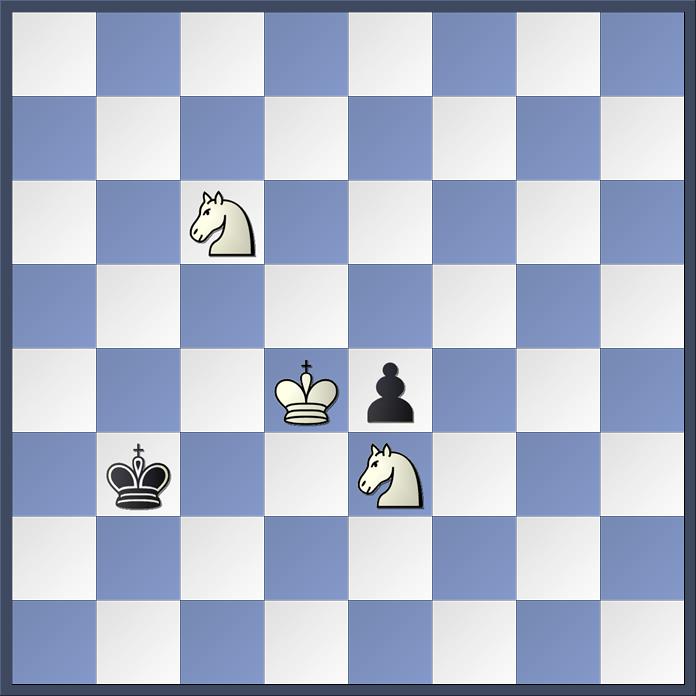
Study 154

Árpád Rusz
Schach
2018-19
3rd Prize
- version -
White wins

1. Ba3! 1. Rxc3+? Kd5 = and both dangerous white pawns are pinned.

a) 1... Qxa3 2. Rxc3+! fork 2... Qxc3 3. Rc8+ Kd4 4. Rxc3 Rxf7+! 4... Kxc3 5. Ke8 +-

The correct move to win is 5. Ke6!! White is very polite, and lets Black to be the first to take the rook. 5... Kxc3 6. Kxf7 mutual zugzwang

mutual zugzwang

6... h2 7. d7 mutual zugzwang 7... h1=Q Black was let to be the first to promote the pawn. 8. d8=Q mutual zugzwang

8... Qb7+ Now we see the reason for white's eccentric play: the black queen has to leave its ideal square. 8... Qf3+ 9. Qf6+ +- 9. Ke6! Contrary to the thematic try, there is no check on e4. 9... Qh1 The black queen returns to h1 but something has changed: the white king is protecting the d5 square! 10. Qa5+! Kxd3 11. Qd5+ +- fork

Thematic try at move 5: 5. Kxf7? Kxc3 mutual zugzwang 6. d7 h2 mutual zugzwang 7. d8=Q h1=Q mutual zugzwang 8. d4 Qb7+ 9. Ke6 9. Qe7 Qd5+ 10. Qe6 Qb7+ 11. Qe7 Qd5+ perpetual check 9... Qe4+ = The e4-square was no longer controlled.

But what if black captures the pawn earlier and doesn't allow the triangulation?
b) 1... Rxf7+!? 2. Kxf7 2. Ke6? Rf6+! 3. Kxf6 Qxa3 = and the queen would capture on c3 with check. 2... Qxa3 3. Rxc3+! Qxc3 4. Rc8+ Kd4

5. d7!! 5. Rxc3? Kxc3 = mutual zugzwang 5... Qb3+ 6. Kf8 6. Kg7? Qb7 -+ 6... Qb4+ 7. Kg8 Qb3+ 8. Kh8! +-

Friday, 3 January 2020

Study 7

This is a 2020 version of a study published in 2002. The initial position now looks much better having no hanging pieces. It is also more economical.

Árpád Rusz
Josten-65 JT
2002-03
- version (2020) -

Draw

1. Ke2 1. Ke1? h3 2. Rh5 g2 3. Kf2 e3+ 4. dxe3+ dxe3+ 5. Kg1 e2 -+ 1... h3 2. Rh5 g2 3. Ng5! h2! 4. Rxh2 g1=Q 5. Nh3+ Kg3 6. Nxg1 Kxh2

Thematic try:
7. Kf2? d3 mutual zugzwang 8. Nf3+ 8. Kf1 Kg3 -+ 8... exf3

9. Kf1 9. Kxf3 Kg1 -+ 9... Kg3 10. Kg1 f2+ 11. Kf1 Kh3! mutual zugzwang 11... Kh2? 12. Kxf2 mutual zugzwang 12... Kh3 13. Kf3 Kh2 14. Kf2 Kh1 15. Kf1 positional draw 12. Kxf2 Kh2 mutual zugzwang 13. Kf1 Kg3 14. Kg1 Kf3 15. Kf1 f4 -+ mutual zugzwang

The right move is:
7. Kf1!! d3 8. Kf2! mutual zugzwang 8. Nf3+? exf3 9. Kf2 Kh1 10. Kf1 f2! mutual zugzwang 11. Kxf2 Kh2 -+ mutual zugzwang 8... f4 9. Nf3+ exf3

10. Kf1 Kg3 11. Kg1 f2+ 12. Kf1 Kh3 13. Kxf2 Kh2 14. Kf1 Kg3 15. Kg1 mutual zugzwang 15... Kf3 16. Kf1 mutual zugzwang 16... Kg3 17. Kg1 f3 18. Kf1 f2 stalemate

Monday, 16 December 2019

Study 175

Árpád Rusz
Strategems
2019
Honourable Mention

White wins

1. Qg6! Kb2 1... Qe2+ 2. Kd5+ Kb2 3. Qe4 Qxe4+ 4. Kxe4 +- 2. f7 Raxb4+! 2... Qe2+ 3. Kf5 Raxb4 4. Qf6+! (4. Bxb4? Rb5+! 5. Kf6?? Qe5#) 4... Kc2 5. Bxb4 Rb5+ 6. Kg6 Qg4+ (6... Qh5+ 7. Kg7 +-) 7. Kh7 Rh5+ 8. Qh6 Rxh6+ 9. Kxh6! (9. Rxh6? Qxb4 =) 9... Qxb4 10. f8=Q +- 3. Bxb4 Qe2+! 3... Rxb4+ 4. Kf5! (4. Kd5? Qe2! = mutual zugzwang) 4... Qf4+ (4... Rf4+ 5. Ke6 Qe2+ 6. Kd7 +- (6. Kd5? Rb4! = mutual zugzwang)) 5. Ke6 Qe3+ 6. Kf6 Qc3+ 7. Ke7 Rb7+ 8. Rd7 Qe5+ 9. Qe6 Qg5+ 10. Qf6+ +-

Thematic try:
4. Kd5? Rxb4 mutual zugzwang 5. f8=Q?? Rb5+ 6. Kc6 6. Kd4 Qe5+ 7. Kd3 Rb3+ 8. Kd2 Qe3+ 9. Kd1 Qc1+ 10. Ke2 Re3+ 11. Kf2 Qe1+ 12. Kg2 Re2+ 13. Kh3 Qh1+ 14. Kg4 Qg1+ 15. Kh4 Rh2# 6... Qc4+ 7. Kd7 Rb7+ 8. Ke8 Qa4+


Position X'

Unfortunately, the newly born queen blocks the escape route of the king…
9. Kd8 Qa8#

The right move is:
4. Kd4!! Triangulation 4... Rxb4+ 5. Kd5!


mutual zugzwang

5... Rb5+ 5... Qc4+ 6. Ke5 Qf4+ 7. Ke6 Qe3+ 8. Kf6 Qc3+ 9. Ke7 Rb7+ 10. Rd7 Qe5+ 11. Qe6 Qg5+ 12. Qf6+ +- 6. Kc6 Qc4+ 7. Kd7 Rb7+ 8. Ke8 Qa4+


Position X

9. Kf8! Qa8+ 10. Kg7 +-

Watch this study on a dynamic board! Click here!

Friday, 26 July 2019

Study 171

Árpád Rusz
Bron-110 MT
2019
3rd/4th Honourable Mention

White wins

1. Bxa5+ 1. e8=Q? Qb3+! (1... Kd1+? 2. Be2+! +-) 2. Kxa1 Qd1+ 3. Kb2 (3. Ka2?? Kc1+ -+) 3... Qc2+ 4. Ka1 Qd1+! perpetual check 1... Kd1+ 1... Ke3+ 2. Ka3 Nc2+ 3. Ka4 +- 2. Bd2! unguarded guard sacrifice 2. Kxa1?? is wrong because the a8 rook doesn't protect the a3 square. 2... Qa3+ -+ 2... Nd3+! 2... Rxd2+ 3. Kxa1 After the bishop sacrifice, the a3 square is protected. 3... Qa3+ 4. Rxa3 +- 3. Bxd3 Rxd2+! 3... Rxf6 4. e8=Q +-

Thematic try:
4. Kxa1? Qxd3! mutual zugzwang. Paradoxically, it will be bad for white that the pawn is going to be promoted! 5. e8=Q 5. Ra2 Rxa2+ 6. Kxa2 Qd5+ 7. Ka3 Qa5+ 8. Kb3 Qb5+ 9. Kc3 Qc5+ 10. Kd3 Qc2+ 11. Ke3 Qc3+! 12. Qxc3 stalemate 5... Qc3+! 6. Qxc3 Ra2+! 7. Kb1 7. Rxa2/Kxa2 stalemate 7... Rb2+! 8. Ka1 Ra2+ perpetual check/stalemate

Solution:
4. Kb1!! Qxd3+ 5. Kxa1!


mutual zugzwang

5... Rc2 5... Ra2+ 6. Kxa2! (6. Rxa2? Qc3+! 7. Rb2 (7. Qxc3 stalemate) 7... Qxf6 8. e8=Q Qa6+ 9. Kb1 Qd3+ 10. Ka2 Qa6+ 11. Kb3 Qb6+ 12. Ka3 Qe3+! 13. Qxe3 stalemate) 6... Qd5+ 7. Kb2 +- 6. Rd8 Rc1+ 7. Ka2 Rc2+ 8. Qb2! Rxb2+ 9. Kxb2 +-

Watch this study on a dynamic board! Click here!

Saturday, 22 September 2018

Study 154

Árpád Rusz
Schach
2018

White wins

1. Nxa3+! (1. Nxc3+? Ka6 =) 1... Qxa3 (1... Ka6 2. Nc4 h2 3. Ra8+ Kb7 4. Ra5 +-) 2. Rb8+ Both dangerous white pawns are pinned but black unpins the d6 pawn and sets a trap: 2... Kc5! 3. Rxc3+! fork. It was very tempting to push the unpinned pawn: 3. d7? Qa7! Both pawns are pinned again. 4. Rc8+ Kd5 5. Rf1 h2 6. Ke8 Qxd7+! (6... Qe3+? 7. Kf8 Rxf7+! 8. Rxf7 Qh6+ 9. Kg8 Qg6+ 10. Rg7 Qe6+ 11. Kh7 Qf5+ 12. Kh8! Qxd7 13. Rxd7+ Ke6 14. Re8+! Kxd7 15. Re1 +-) 7. Kxd7 Rxf7+! 8. Rxf7 h1=Q = 3... Qxc3 4. Rc8+ Kd4 5. Rxc3 Rxf7+! (5... Kxc3 6. Ke8 +-)

6. Ke6!! White is very polite and lets Black to be the first to take the rook. Thematic try: 6. Kxf7? Kxc3 mutual zugzwang 7. d7 h2 mutual zugzwang 8. d8=Q h1=Q mutual zugzwang 9. d4 Qb7+ 10. Ke6 (10. Qe7 Qd5+ perpetual check 11. Qe6 Qb7+ 12. Qe7 Qd5+ perpetual check) 10... Qe4+ = The e4-square was no longer controlled. 6... Kxc3 7. Kxf7 mutual zugzwang

7... h2 8. d7 mutual zugzwang 8... h1=Q Black is also let to be the first to promote the pawn. 9. d8=Q mutual zugzwang

9... Qb7+ Now we see the reason for white's eccentric play: the black queen has to leave its ideal square. 9... Qf3+ 10. Qf6+ +- 10. Ke6! Contrary to the thematic try, now there is no check on e4. 10... Qh1 The black queen returns to h1 but something has changed: the white king is protecting the d5 square! 11. Qa5+! Kxd3 12. Qd5+ +- fork

Watch this study on a dynamic board! Click here!

Monday, 6 March 2017

Study 110

Árpád Rusz
RCS blog
2017

Win

1. Nfe5 Rxe3! 2. Nc4+! 2. Kxe3? Kxb3 = 2... Ka2! Triangulation by the black king! If black captures the pawn immediately, the win is much easier: 2... Kxb3 3. Nxe3 Ka3 4. Kc3 Ka4 5. Kc4 Ka3 6. Nd4 Ka4 7. Nb3 Ka3 8. Nc5 +- etc.) 3. Nxe3 Kxb3 The pawn is securely blockaded by a white knight exactly on the Troitzky line, so by the theory, white must win. The win is surprisingly difficult: white can win only by reaching the same position but with black to move! This can be done only by a 45-move-long manoeuvre!! The play is determined except some duals which can be regarded as minor ones.


cyclic zugzwang - WTM

4. Nd8 The minor duals 4. Ne5 Kb4 5. Ng6 Kb5 6. Nf4; 4. Ne7 Kb4 5. N7d5+ (5. Ng6 Kb5 6. Nf4) 5... Kb5 6. Ke5 (6. Nf4) 6... Kc6 7. Nf4 are all quickly reaching the main line 4... Kb4 5. Ne6 Kb5 6. Nf4 Kc6 7. Ke5 Kd7 8. Kd5 Kc7 9. Ke6 Kc6 10. Ne2! Kc5 11. Kd7 Kb6 12. Kd6 Kb5 13. Kd5!


critical position A

13... Kb6 13... Kb4 14. Kc6 +- 14. Nd4 Kb7 15. Ke6 Ka6 16. Ne2! Kb7 17. Kd6 Kc8 18. Nf4 minor dual 18. Nd4 Kd8 19. Nc6+ Kc8 20. Na5 Kd8 21. Nb7+ Ke8 22. Ke6 Kf8 23. Nd6 etc. reaching the main line 18... Kd8 19. Ne6+/Nh3 Ke8 20. Ng5 Kd8 21. Nf7+ Ke8 22. Ke6 Kf8 23. Nd6 Kg7 24. Kf5 Kh7 25. Kf6 Kh6 26. Ndf5+/Nb5 Kh5 27. Ng3+/Nd4 Kh4 28. Ne2! Kh5 29. Kf5!This position looks like position A but reflected vertically!


critical position B

29... Kh6 The black king has to return... 29... Kh4 30. Kg6 +- 30. Nf4 Kg7 31. Ke6 Kf8 32. Nh5 Ke8 33. Ng7+ Kd8 34. Kd6 Kc8 35. Ne6 Kb7 36. Kc5 Ka6 37. Kc6 Ka5 38. Nc7/Nd4 Kb4 39. Nb5 Ka4 40. Kc5 Kb3 41. Kd4 Kb4 42. Nc7 Ka5 43. Kc5 Ka4 44. Ncd5 Ka5 45. Nb4 Ka4 46. Nc6 Ka3 47. Kd5!! Triangulation by white king! After 47. Kd4? Kb3 one has to start another 45-move long manoeuvre... 47... Kb3 48. Kd4! +-


cyclic zugzwang - BTM

This study features the longest known cyclic zugzwang (45 moves). That is an amazing new record! The study participated in the Troitzky-150 MT but it seems like the judge was not impressed enough to award it.

Watch this study on a dynamic board! Click here!

Sunday, 11 September 2016

Study 105

Á. Rusz & P. Gyarmati
Die Schwalbe
2016

White wins

1. O-O-O! 1. Kd2? Be4 = 1... Be4 2. Re1! 2. Kb2? a3+ 3. Ka1 Kc4! mutual zugzwang (3... Kc3? 4. Rh1! Bxh1 5. h7 Be4 6. h8=Q+ +-) 4. Ka2 Kc3! 5. Kxa3 Kc2 6. Rf1 Kd3! (6... Kd2? 7. Rf2+ +-) 7. Re1 Kd2! = 2... Kc5! 2... Kb3 3. Re3+ +- 3. Kb2 Kb5 3... Kd4 4. Rh1! R sacrifice 4... Bxh1 5. h7 Be4 6. h8=Q+ +- 4. Rc1 Kb4 4... Kb6 5. Ka3 Kb5 6. Ra1/Rf1 Kc4 7. Rd1 Kc5 8. Re1 Kb5 9. Rc1 Ka5 10. Rc5+ Kb6 11. Rh5 +-


cyclic zugzwang - WTM

5. Ka2 Bd5+ 6. Ka1! This is the first king move to a corner square. 6... Be4 7. Kb2 Using a king triangulation, white managed to transfer the move to black.


cyclic zugzwang - BTM

7... a3+ 8. Ka1! With the second king move to a1, white is reaching a mutual zugzwang position. 8. Ka2? Bd5+ 9. Ka1 Be4 positional draw 8... Kb5 8... Kb3 9. Re1 Kc2 10. Re2+ +- 9. Ka2 Kb4 10. Re1 Bd5+ 11. Ka1! +- The third king move to a1! During the 11-moves-long play, white managed to interchange its king and rook on the a1 and e1 squares, while black looks like it has played only one move (a4-a3)!

Watch this study on a dynamic board! Click here!

Sunday, 4 September 2016

Study 103

Á. Rusz
Internet (RCS blog)
2016
- after C. Poisson -

White wins

1. Rb7+! 1. c7? Qd4+ fork 2. Kb8 Qxg7 = 1... Ka5! 1... Kc5 2. c7 Qa3+ 3. Kb8 +- White wins because of the closed a3-f8 diagonal: Qf8 is not possible.; 1... Kc4 2. Be6+ (2. c7? Qa3+ 3. Kb8 Now the a3-f8 diagonal is open. 3... Qf8! 4. Rb1 Kc5 5. Kb7 Qf3+ 6. Kb8 Qf8 positional draw) 2... Kc5 3. c7 Qa3+ 4. Kb8 +- 2. c7 Qd4+ 2... Qd7!? 3. Kb8 (3. Bxd7? stalemate) 3... Qe8 4. Rb3! Qf8 5. Rb2! Qh8 6. Rd2 +- see the main line.

3. Ka8!! Triangulation! Thematic try: 3. Kb8? Qh8! mutual zugzwang 4. Rb1 Qg8! mutual zugzwang 5. Rb2 (5. Rd1? Qb3+ = fork) 5... Qf8! mutual zugzwang 6. Rb3 (6. Rd2 Qb4+ +- fork) 6... Qe8! 7. Rb7 (7. Rd3 Qb5+ = fork) 7... Qh8 positional draw featuring four pairs of corresponding squares!

3... Qh8 4. Kb8 mutual zugzwang 4. Rb8? Qe5! (4... Qg7? 5. Bd7! Qxd7 6. c8=Q +-) 5. Rb7 Qe8! Triangulation 6. Kb8 Qh8! =


2x2 white cluster

4... Qg8 5. Rb1! mutual zugzwang 5... Qf8! 6. Rb2! mutual zugzwang. It is still too early to switch the rook to the d-file. 6. Rd1? Kb6 = The d6 square is protected! 6... Qh8 The queen has to abandon the protection of the b4 and d6 squares. 7. Rd2! Black doesn't have the Qb4+ fork anymore. 7... Kb6 8. Rd6+ The queen is not protecting d6. 8... Kc5 9. Rd8 The rook unpins the bishop. 9... Qb2+ 10. Bb7 +-

Watch this study on a dynamic board! Click here!

Related studies: Study 103a

Sunday, 5 June 2016

Study 43

Árpád Rusz
Internet (Talkchess Forum)
2011

Draw

1. Kd7 b5 2. Kd6!! 2. Kxc6? b4 mutual zugzwang 3. Kb7 b3 4. Kb8 (4. Kxa8 b2 mutual zugzwang) 4... Nb6 5. Kb7 b2 6. Kxb6 b1=Q+ -+ 2... b4 3. Kxc6 mutual zugzwang 3...b3 4. Kb7 b2 5. Kxa8 mutual zugzwang 5...b1=Q stalemate

Watch this study on a dynamic board! Click here!