The results of the WCCI has been published.
1st Place: Oleg Pervakov (RUS)
2nd Place: Martin Minski (GER)
3rd Place: Steffen Slumstrup Nielsen (DEN)
The results of the WCCI has been published.
1st Place: Oleg Pervakov (RUS)
2nd Place: Martin Minski (GER)
3rd Place: Steffen Slumstrup Nielsen (DEN)

1. Nc7! f3! 1... Ra4+ 2. Kf3 Kg5 3. Be6! Ra3+ 4. Ke4 f3 5. Bxd7 +- 2. Kxf3 Kg7

3. Be6! Kf6 4. Bxd7 Ke5 5. Nb5! Switchback 5... Kxd5 6. Bc8! Ra1 7. d7 Rf1+ 8. Kg4 Rf8 9. Nc7+ Kd6 10. Ne6! Rg8+

11. Kh4! 11. Kh5? Ke7 = zz 11... Ke7 12. Kh5 zz 12... Kd6 13. Kh6 +-
Watch this study on a dynamic board! Click here!

1. Nc5+! dxc5 2. Qe4+ Ka7 2... Kc8 3. Qf5+! (3. Rg8+? Kd7 4. Qg4+ Kd6 5. Rxb8 Rxb8 6. Qxh5 Rxb5 =) 3... Kc7 4. Qxc5+ Kd7 5. Qf5+ Kc7 6. Rc4+ +- 3. Qxe7+ Rb7 4. Qxc5+ Ka8 5. b6 Ng3+ 5... Nf4 6. Qa3+ Ra7 7. Qxf3+ Rb7 8. Rxf4 +- 6. Kg1 Ne2+ 7. Kf1! 7. Kf2? Qh2+ = 7... Ng3+ 8. Rxg3
a) 8... Qe8 8... Qxg3 9. Qa3+ Kb8 10. Qf8# 9. Qa5+ 9. Rxf3? Rd7! 10. b7+! Kb8! = 9... Kb8

10. Qe5+! Qxe5 11. Rg8+ Qe8 12. Rxe8#
b) 8... Qd8 9. Qa3+ Kb8

10. Qd6+! Qxd6 11. Rg8+ Qd8 12. Rxd8#
Watch this study on a dynamic board! Click here!

1. Rd8+ Ka7! 1... Kc7 2. Nd5+ Kxd8 3. Rc1 +- 2. Nb5+ cxb5 3. Rc1 b4 4. Rxd3 c4 5. Ra3+! bxa3 6. Ke6! Ka6 7. h4! b5 8. Kd5! Ka5 9. h5 b4 10. h6 b3 11. h7 b2 12. h8=Q bxc1=Q 13. Qa8+ Kb5 14. Qb7+ Ka4 15. Kc5!

a) 15... Qb1 15... Qxd2 16. Qb5# 16. Qa6+ Kb3 17. Qxc4+ Kb2 18. Qc3#

b) 15... Qb2 16. Qa6+ Kb3 17. Qxc4#

Watch this study on a dynamic board! Click here!

1. Rg1+ Ka2 2. Be4! 2. Bf3? Bf1! 3. Rxf1 Ne3 4. Rh1 d2 -+ 2... dxe2 3. Bb1+ Ka3 4. Bd3 Rxd3+ cook: 4... Rc8+! 5. Kd2 Nd4 6. Bxe2 (6. Rg3 Nb3+ 7. Kxe2 Be6 -+ TB7) 6... Rc2+ 7. Kd3 Nxe2 -+ 5. Kxd3 Bf1 6. Kd2 Nd4 7. Rg3+ Ka2 7... Kb2 8. Re3 = zz

8. Rc3! 8. Re3? Kb2 -+ zz 8... Kb1 9. Ra(g)3 Nc2 10. Rb3+ Ka2 11. Kxc2 e1=Q 12. Ra3+! Kxa3 stalemate

Watch this study on a dynamic board! Click here!

1. Kd7! Rc4! 2. Re1! Rd4+ Imagine you have this position in a tournament game. I am sure that you would play - just like me - Ke7. Would you not?

3. Ke8!! 3. Ke7? Rf4!! mutual zugzwang: the white rook is in a focal position, because it must observe at the same time e4 & c1 4. f7+ Kg7! 5. Rc1 Re4+! = 3... Rf4 The rook must control f8. 4. Ke7!! mutual zugzwang: this way, it is the black rook which is in a focal position, because it must observe at the same time a4 & f8.

4... b4 4... Re4+ 5. Rxe4! c1=Q 6. f7+ Kg7 7. f8=Q+ +- 5. Ra1!! No more Ra4. 5... Re4+ 6. Kd6(7) Rd4+ 7. Ke6! Switchback. 7... Rd8 8. g7! Threatening Rh1. 8... Rc8 9. Rh1! Re8+ 9... Rc6+ 10. Ke5! Rc5+ 11. Kd6! Rg5 12. Rh8+! Kf7 13. Rf8+! +-; 9... c1=Q 10. Rh8# 10. Kf5! Kf7 11. Ra1!! Switchback. The chessboard is just wide enough! 11... Rc8 12. Ra7+! Kg8 13. Kg6! c1=Q 14. f7# Sorry that the white Rook did not disappear for a model mate! The study features 14 forced moves with a funny ZZ and a "swallow" ("Schwalbe") of the rook c1-e1-a1-h1-a1.
"A non-standard rook endgame with an unexpected mutual zugzwang and very wide play of the white rook" (judge Oleg Pervakov).
Watch this study on a dynamic board! Click here!

White hopes to have Kg7, Ng6 vs Ke8, or symmetrically Kd7, Nd6 vs Kf8. 1. e6! Threatening f7+ & Ng6+. 1... Rf3! It would be a draw with the Rook in f1, but a shorter win with the Rook in f2. 2. Ke5! Kf8! 3. Ng6+! Ke8! 4. Nh8!! A new version of the "strongest attacking move in the world" of Nimzovitch-Rubinstein 1926: 18 Ng3-h1!! pour 19 Nf2. 4... Kf8 5. Nf7! Rf2! Paradoxical defence: the Rook is best on the 1st rank but does not access it immediately for tempo reason. 6. Nd6! Threatening e7+. 6... Re2+ 7. Kd5! Re1! Now the only way to make progress is to ensure that Black is to move. It will take 8 moves. The reason will appear at the 18th move.
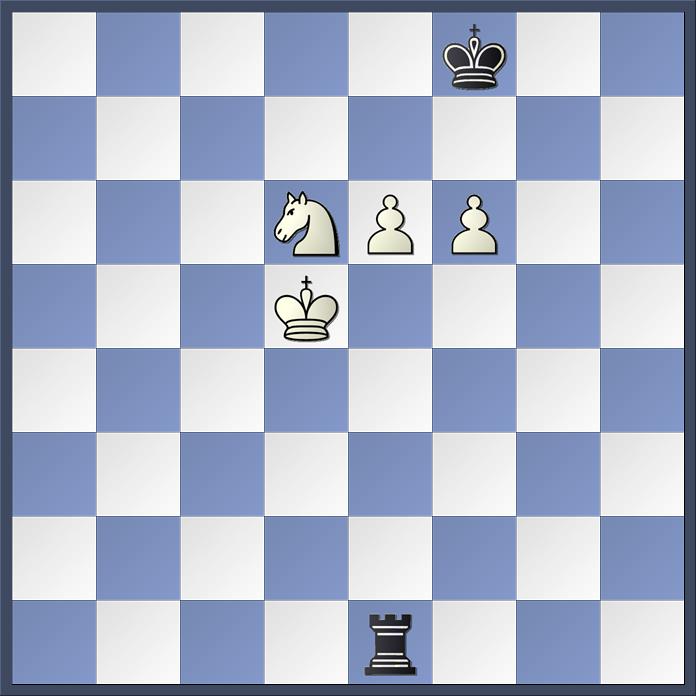
8. Nc4!! Threatening Kd6-d7.
Unfortunately, it seems that there is an alternative way to win avoiding to reach the BTM side of the cycling zugzwang position. That means the position from the diagram is not a true cyclic zugzwang. 8. Nf7! Ke8 9. Nh8! Rg1 10. Kd6! Rd1+ 11. Ke5 Re1+ 12. Kf5 Rf1+ 13. Kg5! Kf8 14. Ng6+ Ke8 15. Nh4 Kf8 16. Kg6 Re1 17. Kf5 Rf1+ 18. Kg5! Rg1+ 19. Kh6 Rh1 20. Kh5 Kg8 21. Kg5 Rg1+ 22. Kf5 Re1 23. Ng6 Rf1+ 24. Ke5 +-
8... Ke8 Here White uses a simple triangulation. 9. Kd6!! The WK relays the N on the turntable d6. The threat is f7+ followed by Ne5. 9... Rf1! Benefit there is no more Nd6+ & e7+. 10. Ke5! Re1+ 11. Kd5! Simple Z (no reciprocal). 11... Rd1+! 12. Kc6! To bring another simple Z. 12... Rc1 The threat was Nd6+ & e7+. 13. Kc5!! It is more usual to protect a Knight while unpinning it, but 13 Kb5? draws and 13 Kd5?! is losing time. 13... Re1 Black is in zugzwang must make concessions : either the Rook unpins the Knight, either it comes on the 2nd rank (less favourable), either the BK lets his counterpart on d8 or on f8. 14. Nd6+! Kf8 15. Kd5! This is the position after the 7th black move, but it is now black to move.
15... Re2! 16. Nf5!! It was necessary to move the BR from e1 to e2 to realize the decisive plan. The threat is Kd6-d7 again. 16... Ke8! 17. f7+! At last, White can compromise his pawn-chain: this should not win with the Rook on e1. 17... Kf8 18. Nh4!! This requires that the Rook is in 2nd rank, otherwise, it would reach the "g" file, preventing Ng6+. 18... Rd2+ 19. Kc5!! The WK likes this square (see 13th move) but here, we have the feeling he deserts! 19... Rc2+ 20. Kd4! It was an illusion: he comes back, to the meeting of the BR. 20... Rf2 21. Ng6+! Kg7 22. Ne5! Threatening e7. The N relieves the WK on the turntable e5. 22... Kf8 23. Kd5! Again the threat Ng6+. 23... Rd2+ 24. Kc6! Toward d8. 24... Rc2+ 25. Kd7! Rd2+ 26. Kc7! Rc2+ 27. Kd8! Rd2+ 28. Nd7+! +- So, White has after the 15th black move the same position than after the 7th, except for one little detail ("la petite différence"), the Rook is on e2 instead of e1, allowing the implementation of the plan. Preparation of 8 moves, for a total of 23 fully determined moves.
Watch this study on a dynamic board! Click here!

Thematic try: 1. Kc6? g2! 2. Rc1 Ke5 3. Rg1 Ke4 4. Rxg2 Kxe3 =

1. Kb6!! The square c6 must be left free for the Rook. 1. Rc6+? Ke5! 2. Rg6 f4! 3. Rg5+ Ke4! 4. exf4 Kxf4 = 1... g2 1... Kf6 2. Rc8! +- 2. Rc6+! Kd5 2... Kf7 3. Rc1 +- 3. Rg6! Ke4

4. Rg3!! 4. Rxg2? Kxe3 = 4... Kd3 4... g1=Q 5. Rxg1 Kxe3 6. Re1+!! Kd3 7. Rf1! Ke4 8. Ka(b,c)5 f4 9. Kb(c)4 Ke3 10. Kc3 f3 11. Re1+! +- 5. Kc5! Ke2 6. Rxg2+! Kxe3

7. Rg3+!! +- Switchback and echo of 6 Re1+!! in the 4th black move line. 7. Kd5? f4 8. Ra2 f3 9. Ra3+ Ke2 10. Ke4 f2 11. Ra2+ Ke1 12. Ke3 f1=N+! =; 7. Kc4? f4 8. Rg8 f3 9. Re8+ Kd2! =
Watch this study on a dynamic board! Click here!

1. Bd3!! 1. Be2? b5! 2. Bd1 d4!! (2... b4? 3. Bb3! d4 4. Ke6! d3 5. Ke5 d2 6. Ke4 =) 3. Be2 b4! 4. Ke6 d3!! (4... b3? 5. Ke5 =) 5. Bxd3 Kd4! 6. Bc2 c5 -+; 1. Ke6? b5! 2. Ke5 b4! 3. Be2 b3! 4. Bd3 b2! -+ (4... Kb4? 5. Kd4! b2 6. Bc2! (6. Bb1? Kb3 -+ zz) 6... Ka3 7. Kc5! =) 1... b5 2. Bb1!! As far as possible from the BK, and also from the pawns. 2. Bc2? Kc4!! (2... d4? 3. Bd3! b4 4. Ke6! =; or symmetrically 2... b4? 3. Bb3! d4 4. Ke6! =) 3. Kxc6 b4 (or 3... d4) 4. Kb6 (4. Kd6 d4! 5. Ke5 d3! -+) 4... d4! 5. Ka5 b3! -+ 2... b4 3. Ba2!! The key square, preventing both ...b3 & ...Kc4. 3... d4 4. Ke6! d3 5. Ke5! d2 6. Bb3! =

Watch this study on a dynamic board! Click here!

"There are 3 candidates moves: push the "a" pawn, push the "g" pawn or activate the white King. None of them is good, but you must make a "silly" move, a check ("weak players see a check, make a check !") and afterwards, according to the place the black King went, all the candidate moves now occur."
Try1: 1. a5? Kd7! =
Try2: 1. g6? Bf8! =
Try3: 1. Kg6?! Bc1! 2.Kh5 Ba3 waste of time.
Solution: 1. Bb3+!!
a) 1... Ke5 2. a5! Bc5 3. g6 (minor dual 3.a6 +-) 3... Kf6 4. Kh6 Bf8+ 5. Kh7 +-
b) 1... Ke7 2. g6! +-
c) 1... Kd7 2. Kg6! +-
Although the logic of the intention is interesting, at first sight, this study feels completely wrong, with lots of duals. See this link: Syzygy endgame tablebases
The author has a detailed analysis here showing that, despite the numerous time losing duals, the study is still sound.
Watch this study on a dynamic board! Click here!

1. Bg2! W must prevent ...e5-e4, at least when the Bishop is misplaced. (1. Bh3? e4! -+) 1... Rg1 (1... Kd3 2. Bh3! e4 3. Bf5! Re2 4. Bg6 = This reminds a famous positional draw... with another black Rook in e4 instead of the pawn.) 2. Bh3!! (2. Bf3? Ke3! 3. Be4 Kf4 -+; 2. Be4? Rg5! 3. Ke6 Ke3 -+) 2... Rg5 Threatening ...Ke3-f4. (2... Rg3 3. Be6? (3. Bf5/c8! =) 3... Rg5! 4. Ke4 Kc3!! (ZZ on the wrong side) 5. Bf7 (5. Bf5 Rxf5! 6. Kxf5 Kd4! -+; 5. Kd5 Kd3 -+; 5. Bh3 Kc4! -+) 5... Kb4! (threatening ...Kc5-d6) 6. Kd5 Kb5! 7. Be8+ Kb6 8. Bd7 Kc7 9. Be6 Kd8! 10. Ke4 Ke7! 11. Bf5 Kd6 -+) 3. Ke4! Kc3 4. Be6!! This ZZ comes, if I am not wrong, from Timman 1983. The Bishop is in a focal position : it must prevent ...Kc4 and be ready , on ...Kb4, to play Bf5 before the BK accesses to d6. See comment of the 2nd black move. (4. Bc8? Kc4! 5. Ba6+ Kc5! -+; 4. Kd5? Kd3! toward f4 (4... Kb4? 5. Bf1!! Kc3 6. Ba6!! =); 4. Bf5? Rxf5! 5. Kxf5 Kd4 -+; 4. Bf1? Rg1! 5. Bh3 Re1+! 6. Kd5 e4! -+)

4... Rh5 (4... Kb4 5. Bf5! =) 5. Bf7!! The 4th heroic move of the Bishop. The flexibility of the Rook is too narrow : always the "short side" story, like in Rook + pawn / Rook ! With an "i" file, B could play 5...Ri5! 6. Be6 Rg5! obtaining the ZZ on the good side for Black. 5... Rg5 (5... Rh7 6. Be6! Re7 7. Kxe5 =) 6. Be6! =
Watch this study on a dynamic board! Click here!
Most of the annotations on this page are by the author of the studies, Alain Villeneuve.

1. Nb3+ Kxa4 2. Qa1+ Qxa1 3. Nxa1 Bd6 4. f8=Q! 4. Kb7? Rc7+ 5. Kxa6 Rc8 6. Kb7 Rc7+ = 4... Bxf8 5. Kb7 Rb4+

6. Kc7! 6. Kxa6? Bc5 7. a8=Q Rb6+ = 6... Rc4+ 7. Kxd7 7. Kd8? Bb4 (or 7... Rc1 8. a8=Q Bb4) 8. a8=Q Rc1 9. Qxa6+ Ba5+ 10. Kxd7 Rxa1 = 7... Rd4+ 8. Ke8 Be7 9. Kxe7 Re4+ 10. Kd7 Rd4+ 11. Kc7 Rc4+ 12. Kb7 Rb4+ 13. Kxa6 Rb5

14. Nb3! +-
Watch this study on a dynamic board! Click here!

1. Nf4+ Kh4 1... Kg4 2. Bc6 Re1+ 3. Kd4 h5 4. Ng2 +-; 1... Kg5 2. Bd5 h5 3. Ng2 Ra3 4. Bd6 +- 2. Bd5! 2. Bc6? Rh1 3. Ng2+ Kh3 4. Be5 Kxg2 = 2... Rh1 3. Ng2+ Kh3 4. Bd6! Kxg2 5. Kf4+ Kg1 6. Kg3 Rh5 6... h5 7. Bc5+ +- 7. Bc5+ Kf1 8. Bg2+! Ke1 9. Bb4+ Ke2 10. Bf3+ +-
Watch this study on a dynamic board! Click here!

1. g6 Bxg6+ 2. Kg8 Kh6 3. exd3 Nf5 4. Kxh8 Ne7

Thematic try: 5. Bb3? Bh7! 5... Bxd3? 6. Bf7 = zz 6. Bf7 6. d4 Ng6# 6... Bxd3 zz 7. Be6 Bh7 8. Bf7 Bg8! 9. Bxg8 9. Be8 Ba2 10. d3 Bb3 11. d4 Bd5! -+ zz 9... Ng6#
Solution: 5. d4! Be4 5... Bh7 6. Bh5! = 6. Bb3! Bh7 7. Bf7 Bg8 8. Be8 Ba2

9. d5! 9. d3? Bd5 -+ zz 9... Bxd5 10. d4 zz 10... Ba2 11. d5! Bxd5 12. Bf7! Bxf7 stalemate
Watch this study on a dynamic board! Click here!

1. Bg3+ Kh1! 1... Kg1 2. dxc7 (2. Nh3+) 2... Bxc7 3. Nh3+ +- 2. Ne2 2. Kh3? Kg1! 3. dxc7 Bxc7 4. Ne2+ Kf1 = 2... cxd6 3. Kh3 Ba7

4. Bh2! 4. Bxd6? Bf2 = zz; 4. Bf4? d5 5. Bh2 Bf2 6. Bg1 Be1 7. Ba7 d4! (7... d6? 8. Bd4 +- zz) 8. Bxd4 d5 = zz 4... Bf2 5. Bxd6 zz Ba7 6. Bh2 Bf2 6... d5 7. Ng3#

7. Bg1! Bxg1 7... Be1 e.g. 8. Be3 d6 9. Ba7 d5 10. Bd4! +- zz 8. Ng3#
Watch this study on a dynamic board! Click here!

1. Qe6 Bg5+ 2. Kd1 f1=Q+ 3. Nxf1 Rxf1+ 4. Qe1! 4. Ke2? Rxb1 -+ 4... Rxe1+ 4... Ne3+ 5. Ke2 Rxe1+ 6. Rxe1 = 5. Kxe1 Nd3+ 6. Ke2! Nc1+ 7. Kd1 Ne3+! 8. Kxc1 8. Ke1? Kc2 9. Ra1 Bh4# 8... Ka2

9. b3! Nc4+ 10. Kd1! 10. Kc2? Na3+ -+ 10... Ne3+ 11. Kc1 Nf5+ 12. Kc2 Ne3+ 13. Kc1 Nc4+ 14. Kd1! =
Watch this study on a dynamic board! Click here!

1. Bf2+ Kf3 2. Ra2! Qxb1+ 3. Kxh2 Qxa2! 4. Qxa2 g3+ 5. Bxg3 fxg3+ 6. Kg1 Nxc3! 7. Qc4 Ra1+ 8. Qf1+ Rxf1+ 9. Kxf1 g2+ 10. Kg1 Ne2+ 11. Kh2 Kf2
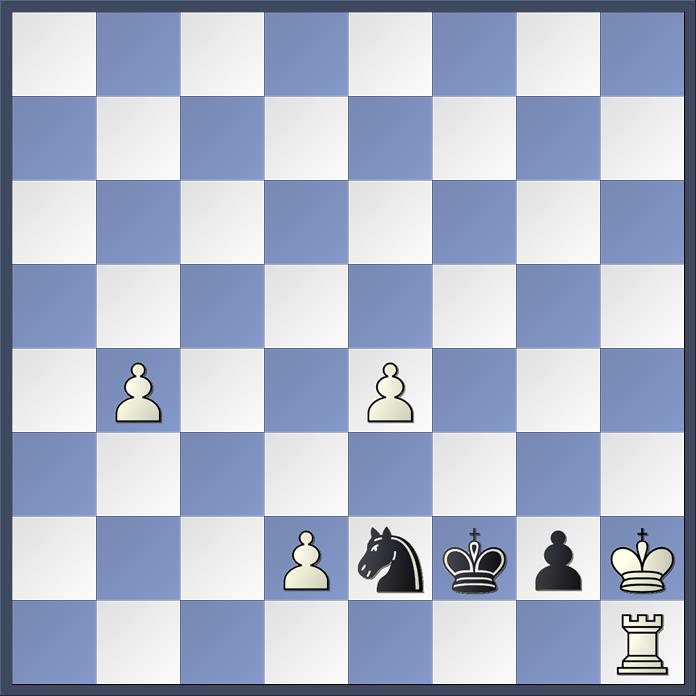
12. Re1! 12. Ra1? Ng3 13. Kh3 Nf1 -+ 12... Ng3 13. Kh3 Kxe1 13... Nf1?? 14. Re2+! Kxe2 15. Kxg2 +- 14. Kxg2 =

1. Re1+! 1. Rxd4? c2+ 2. Ka2 c1=Q = 1... Kxe1 2. Nf3+ Ke2 cook: 2... Kd1! 3. Nxd4 f5! 4. h4 f4 5. h5 f3 = 3. Nxd4+ Kxd3 4. h4! Kxd4 5. h5 Ke5 6. h6 +-
Watch this study on a dynamic board! Click here!

1. Be2+ Kh4 2. Rh3+ Kg5 3. Rg3+ Kh4 4. Rg4+ Kh5

5. Rxe4+! Thematic try: 5. Rf4+? Kg5 6. gxh8=N Be8! = 5... Kg5 6. Rg4+ Kh5 7. Rxd4+ Kg5 8. Rg4+ Kh5 9. Rxc4+ Kg5 10. Rg4+ Kh5 11. Rxb4+ Kg5 12. Rg4+ Kh5 13. Rxa4+ Kg5 14. Rg4+ Kh5 15. Rf4+ Kg5 16. gxh8=N! Ra7 17. Rg4+ Kh5 18. Rxg6+ Kh4 19. Rg4+ Kh5 20. Rg3+ Kh4 21. Rh3+ Kg5 22. Rh5#
Watch this study on a dynamic board! Click here!

1. Nf5+ Kxg6 2. Ng7! Kxg7 3. Bg2 Kg6 4. Be4+ Kg7 5. Bc6 dual 5. Bg3! h4 6. Be5# 5... Kg6 6. Be8+ Kg7 7. Ba4 Kg6 8. Bc2+ Kg7 9. e4 Kg6 10. e5+ Kg7 11. Bf6+ exf6 12. exf6#
Watch this study on a dynamic board! Click here!

1. Bf6! exf6 1... Qh5+ 2. Kxh5 exf6 3. Ne7+ Kxg7 4. Nf5+ = 2. Ne7+ Kxg7 3. Nf5+! Kg6 3... Qxf5 stalemate 4. Ne7+ Kh6 5. Nf5+ Kg6 6. Ne7+ Kg7 7. Nf5+ =
Watch this study on a dynamic board! Click here!

1. g7 a1=Q+
Logical try: 2. Kb7? Qg1 3. g8=Q Qxg8 4. Nxg8 d5! 5. f6 Ke6 6. e5 d4 7. Nh6 d3 8. f7! Ke7 9. e6 d2 10. Ng8+! Kf8 11. Nf6 d1=Q 12. Nxh7+! Ke7! 13. f8=Q+ Kxe6 14. Qf6+ Kd7 15. Nf8+ Ke8 16. Ne6 Qd6!! zz

17. Kc8 17. Nc7+ Kd7 18. Qf7+ Qe7 19. Qf5+ Kd6 20. Qd3+ Ke5 21. Qe3+ Kf6 = 17... Qd7+ 18. Kb8 Qe7!! The only way! It would be easy to make a mistake: 18... Qd6+? 19. Kb7! zz as in the main solution 19. Nc7+ 19. Ng7+ Kd7 20. Qf5+ Kd6 21. Qd3+ Ke5 22. Qe3+ Kf6 23. Nh5+ Kf7 = 19... Kd7!! 19... Kd8? 20. Qf4! etc. as in the main solution 20. Qd4+ Qd6 21. Qg7+ Kd8! 22. Qg8+ Ke7! 23. Qg7+ Kd8 24. Qg5+ Kd7 positional draw
Solution: 2. Kb8!! Qg1! 2... Kxe4 3. g8=Q Qf6 4. Qxh7 d5 5. Qg6 Qd8+ 6. Kb7 Qd7+ 7. Kb6 Qd8+ 8. Kxc6 +-; 2... Qa6 3. g8=Q Qb6+ 4. Kc8 Qa6+ 5. Kxd7 +- 3. g8=Q Qxg8+ 4. Nxg8 d5! 4... c5 5. Nh6 c4 6. Ng4+ Kxe4 7. f6 c3 8. Ne3! Kxe3 9. f7 c2 10. f8=Q c1=Q 11. Qh6+ +-; 4... h5 5. Kc7 h4 6. Nh6 h3 7. Ng4+ Kf4 8. Nh2 +- 5. f6 Ke6 6. e5 d4 7. Nh6 d3 8. f7! 8. Ng4? h5 9. Nf2 d2 10. Kc7 h4! 11. f7 Kxf7 12. Kd7 h3 13. e6+ Kg7 14. e7 h2 = 8... Ke7 9. e6 d2 Systematic movement 10. Ng8+! 10. Nf5+? Kxe6 11. f8=Q d1=Q 12. Ng7+ Ke5! 13. Qf5+ Kd6 14. Qf8+ Ke5! 15. Qf5+ Kd6 positional draw 10... Kf8 10... Kxe6 11. f8=Q d1=Q 12. Qf6+ Kd5 13. Qd8+ +- 11. Nf6 d1=Q Black excelsior! 12. Nxh7+! 12. Nd7+? Ke7 13. f8=Q+ Kxe6 14. Nc5+ Ke5 15. Qe7+ Kf4/Kf5 = 12... Ke7! 12... Kg7 13. f8=Q+ Kxh7 14. Qf7+ Kh6 15. e7 +- 13. f8=Q+ Kxe6 14. Qf6+ Kd7 15. Nf8+ Ke8 16. Ne6! Qd6+ 16... Qb3+ 17. Kc8 +- 17. Kb7!! zz

17... Qe7+! 18. Nc7+! Kd8 18... Kd7 19. Qxc6+ With a king on b7, this is both possible and necessary. 19... Kd8 20. Qd5+ with a quick mate 19. Qf4! 19. Qh8+? Kd7 20. Qd4+ Qd6 21. Qg7+ Kd8! 22. Qg8+ Ke7 23. Qg7+ Kd8 24. Qg5+ Kd7! positional draw, as in Logical try 19... Qa3 20. Qd4+/Qg5+ Ke7 21. Qg7+ Kd8 22. Ne6+ Ke8 23. Qg8+ Kd7 24. Qc8+ Kd6 25. Qf8+ +-
“Large-scale study of the grandmaster level with a record range effect of foresight, original systematic movement, mutual tricks and a bright finale”. (Judge Y. Bazlov)
Watch this study on a dynamic board! Click here!

1. b5 Ra7! 1... Ra8+ 2. Kd7 Ra7+ 3. Ke6 Nxe7 4. b6 Rxa5 5. b7! =; 1... Rxa5 2. Kf8! Nd6 3. e8=Q Nxe8 4. Kxe8 Rxb5 5. d6 = 2. Kd8! Nxe7! 2... Rxe7 3. a6 Rh7 4. b6 = 3. b6 Rxa5 4. d6! 4. Kxe7? Rxd5 -+ 4... Nc6+ 5. Kc7 Rc5

Thematic try: 6. b7? Nb4+ 7. Kb6 Kc4 8. b8=N! Rc8! -+

8... Rb5+? 9. Kc7 Nd5+ 10. Kc8 Rc5+ 11. Kb7 Nf4 12. d7 Ne6 13. Nc6 Rd5 14. Kc8 Rd6 15. Nd8!! (15. d8=N? Nf8 -+) 15... Nc5 16. Nf7! Rc6+ 17. Kd8 Kd5 18. Ke8 Re6+ 19. Kd8 Kd4 20. Kc8 positional draw; 8... Rh5? 9. d7 Nd5+ 10. Kb7 (or} 10. Kc6 Rh6+ 11. Kb7) 10... Rh7 11. Kc6 Rh8 12. Na6 Rh6+ 13. Kb7 Rb6+ 14. Kc8 Ne7+ 15. Kc7 Nd5+ 16. Kc8 =
Solution: 6. d7! Nd4+ 6... Na5+ 7. Kb8 Nc6+ 8. Kc7 = 7. Kd6 Kc4 8. d8=N! Rd5+ 8... Rc8

a) 14... Rd5+ 15. Kc7 Rd1 16. b7 Nd5+ 17. Kd7!! 17. Kc8? Nb6+ 18. Kc7 Kb5 19. b8=N (19. b8=Q Rd7#) 19... Nd5+ -+; 17. Kc6? Nb4+ 18. Kc7 Na6+ 19. Kb6 Nc5 20. Kc7 Kd5 21. b8=N Rh1 -+ 17... Nb4+ 18. Kc8! Na6 19. Nc6 Rd6 20. b8=N! Nc5 21. Na5+! Kd5 22. Nb7! =
b) 14... Ne4+ 15. Kd7 Rb5! 16. b7 Nc5+ 17. Kc8! Na6 18. Nc6 Rc5 18... Rb6 19. b8=N! = (19. Nb8? Nc5 -+) 19. Kd7 Rd5+ 20. Kc8 Rc5 20... Rd6 21. b8=N! Nc5 22. Na5+ Kd5 23. Nb7! = 21. Kd7 Rb5 22. Kc8 positional draw
Watch this study on a dynamic board! Click here!

1. g7 Rg5 2. Kxc6 Rg6+ 3. Kxd5 Nf5! 4. g8=Q+! 4. Kxe5? Nxg7! 5. Rxe3 Re6+ 6. Kf4 Nh5+! -+; 4. Ke4? Rxg7! 5. Kxf5 Bxc5 6. Rc3 Rc7 -+ 4... Rxg8 5. Kxe5! 5. Ra8+? Kb(c,d)7 6. Rxg8 Ne7+ -+ 5... Rg5 6. Kf6 Rh5 7. Kg6 Rg5+ 8. Kf6 Rh5 9. Kg6 Bxc5!! 10. Ra2! 10. Rc3? Ng3 11. f4 Ne2(4) -+ 10... Ng3

11. Rg2 Rh8! 11... Bd6 12. Rxg3 Bxg3 13. Kxh5 = 12. Rc2 12. Rxg3? Rg8+ -+ 12... Rg8+ 13. Kh6! 13. Kf6? Rf8+ 14. Kg5 Rf5+ 15. Kg4 Nf1!! 16. Kxf5 Ne3+ -+ 13... Rh8+ 13... Nf5+ 14. Kh5 Ng7+ 15. Kg6! Ne8+ 16. Kh6! = 14. Kg6 Rh5 15. Rg2 Rh3 16. Rc2 Rh5 17. Rg2! positional draw
Watch this study on a dynamic board! Click here!

Logical try: 1. Bxg4? Rxg4 2. Ng6 Nd5+ 3. Kxd6 Nf6 4. Ke7 Ng8+ 5. Kf8 Nh6 6. g8=Q Nxg8 7. Kxg8 Rg5! 7... Rg2? 8. Kf7! Rh2 9. Nf4 Rh4 10. Kg7 Rg4+ 11. Ng6! = 8. h6 Rxg6+ 9. Kh7

9... Rg2!! 10. Kh8 Ne2 11. h7 Ng3! 12. Kg7 Nf5+ 13. Kf6 Rh2 -+
1. Bf3+!! Kh2 2. Bxg4 Rxg4 3. Ng6 3. h6? Nf5 4. h7 Rxg7+ -+ 3... Nd5+ 4. Kxd6 Nf6 5. Ke7! Ng8+ 6. Kf8 Nh6 7. g8=Q Nxg8 8. Kxg8 Rg5! 8... Ne2 9. Kf7 Nd4 10. h6 = 9. h6! Rxg6+ 10. Kh7

10... Rg2 10... Rg3 11. Kh8 Ne2 12. h7 Nf4 stalemate 11. Kh8 Ne2 12. h7 Ng3 13. Kg7 Ne4+ 13... Nh5+ 14. Kh6 =; 13... Nf5+ 14. Kf6(8) = 14. Kf8 =
Judges A. Yusupov, V.Barskij, O.Pervakov: “Another great logical study with foresight for 13 moves. It is a pity that the black rook g4 essentially did not take part in the game”.
Watch this study on a dynamic board! Click here!

1. Nc4 Be6+ 1... Kb5 2. Bxd4 +-
Logical try: 2. Kh8? Bxc4 3. dxc4 d3! 4. d7 Bc7 5. Bd6! d2! 6. Bxc7 d1=Q 7. d8=Q Qxd8+ 8. Bxd8 f3 9. g6 f2 10. g7 f1=Q 11. g8=Q Qf7!! zz

12. Qxf7 stalemate
Solution: 2. Kh7! 2. Kf8? Bxc4 3. d7 Bc7 4. dxc4 d3 5. g6 d2 6. g7 d1=Q 7. g8=Q Qxd7 = 2... Bxc4 2... Kb5 3. Bxd4 Kc6 4. g6 +- 3. dxc4 d3! 3... Bxd6!? 4. Bxd4! +- (4. Bxd6? f3 5. Bg3 d3 =) 4. d7 Bc7 5. Bd6! d2! 5... Kb7 6. Bxf4! Kc6 7. g6 Kxd7 8. g7 Bxf4 9. g8=Q +- 6. Bxc7 d1=Q 7. d8=Q Qxd8! 8. Bxd8 f3 9. g6 f2 10. g7 f1=Q 11. g8=Q Qf7+!

12. Kh8!! zz 12. Qxf7? stalemate 12... Qh5+ 13. Kg7 Qg4+ 14. Kf8 +-
Judge Harold van der Heijden: “This shows us a good construction of a (non)-obvious stalemate, which surprisingly seems to be original. The zugzwang position is remarkable. It is a pity that the less obvious move (2.Kh8?) is the thematic try. The bKa6 does not play”.
Watch this study on a dynamic board! Click here!

1. e8=Q+ Ne5 2. Qa8+ d5 3. Nxh4 (3. Qa4+? Kd3 4. Nxh4 a1=Q! 5. Qxa1 Rb7+ 6. Ka2 Ra7+ =; 3. N1g3+? Kd3 4. Nxh4 a1=Q! 5. Qxa1 Rb7+ 6. Ka2 Ra7+ =) 3... a1=N+! (3... g1=Q 4. Qa4+! d4! 5. Qa8+ Kd3 (5... Rd5 6. Nf5! +-) 6. Ng2! a1=N+! 7. Kb2! Nc4+ 8. Kb1! Kc3 9. Qxa1+ Kb4 10. Ne1! Qg6+ 11. Nc2+ Kb5 12. Rb8+ +-) 4. Qxa1 Rb7+!

Logical try: 5. Kc3? d4+! 6. Kc2 Rc7+! (6... d3+? 7. Kc3! Rc7+ 8. Kb4 Rb7+ 9. Kc5 +-) 7. Kd1 g1=Q 8. Rf4+! Kxf4 (8... Kd5 9. Qa2+ Rc4 10. Nf5! e2+ 11. Qxe2 +-) 9. Qxd4+ Kg5 10. Qxe5+ Kxh4 (or 10...Kg4 11. Qe6+ Kh5 12. Qe8+ Kxh4 13. Qh8+) 11. Qh8+ Kg4 12. Qg8+ Kf3! 13. Qxg1 e2+ 14. Kd2 Rd7+! = there is no d5 pawn and the d-file is open (16... Rc2+? 17. Kxc2 +-)
Solution: 5. Kc2!! Rc7+ 6. Kd1 g1=Q 7. Rf4+! (7. Qb1+? Nd3 8. Re8+ Kf4 9. Rf8+ (9. Qxd3 Qg4+ 10. Qe2 Rc1+! 11. Kxc1 Qxe2 =) 9... Ke4 10. Ke2 Qg4+! 11. Rf3 Rc3! 12. Ng3+ Kd4 13. Nhf5+ Kc5 =; 7. Qxe5+? Kxe5 8. Nf3+ Ke6 9. Nxg1 Rf7 10. Re8+ Kd7 =) 7... Kxf4 8. Qd4+ Kg5 9. Qxe5+ Kg4! 10. Qe6+ Kh5! 11. Qe8+! Kxh4 Now the knight must be captured. (11... Kh6 12. Qh8+ Rh7 13. Nf5+ Kg5 14. Qg8+ +-) 12. Qh8+ Kg4 13. Qg8+ skewer 13... Kf3! 14. Qxg1 e2+ 15. Kd2! The d5-pawn prevents a check on the d-file. Remains... 15... Rc2+!

Logical try: 16. Kxc2? e1=Q 17. Nd2+ Ke2 18. Qg4+ Kf2 19. Qh4+ Ke2 20. Qh5+ Kf2 21. Qh2+ Ke3 zz 22. Qe5+ Kf2 23. Qh2+ Ke3 positional draw
Solution: 16. Kd3!! Rc3+! 17. Kxc3! In check! 17... e1=Q+ 18. Nd2+! Ke2 19. Qg4+ Kf2 20. Qh4+ Ke2 21. Qh5+ Kf2 22. Qh2+ Ke3 23. Kc2 !! zz d4 (23... Qe2 24. Qg3+ Kd4 25. Qc3#; 23... Qf2 24. Qe5#) 24. Nc4+ Kf3 25. Ne5+ Ke4 26. Qh7+ Ke3 27. Qh6+ Ke4 (27... Ke2 28. Qh5+ Ke3 29. Qf3#) 28. Qc6+ Kf5 29. Qg6+ Kxe5 (29... Kf4 30. Nd3+ +-) 30. Qe8+ +- skewer
Judge Sergei Osintsev: “Grand idea! Two consecutive 'foresight effects'! The turned Queen walked almost the entire chess Board and returned to the starting position, dominating along the way over the two turned black queens! Perhaps this nuance was decisive in the choice of the author of the opening game, despite the capture of the knight non-playing black Queen. But both knights became playing - black and white. But nonetheless…”
Watch this study on a dynamic board! Click here!
